Issue #26 - EDIÇÃO ESPECIAL DE NATAL: O Ano em que a Inteligência Artificial se Tornou Real
Olá a todos!
Para esta 26ª edição, decidi fazer uma pausa. Este é um boletim informativo especial de Natal e o último do ano — criado de forma um pouco diferente, sem as seções ou anúncios habituais. Apenas um momento para desacelerar e refletir sobre o que este ano realmente significou para nós como gerentes de projeto.
Com o fim de 2025 se aproximando, uma coisa parece clara: este foi o ano em que a IA se consolidou de vez em nossas vidas profissionais. Não como uma promessa ou experimento, mas como uma presença real que remodela a forma como pensamos, decidimos e trabalhamos — em todos os setores, funções e escolhas do dia a dia.
Ao longo do ano, compartilhei histórias das áreas de saúde, educação, criatividade e liderança que apontavam na mesma direção. A IA transformou a escassez de informação em abundância, tornando o julgamento humano, a ética e a capacidade de interpretação mais importantes do que nunca.
Esta edição é um convite à reflexão sobre a liderança nesta nova realidade — onde a adoção da IA não é apenas uma decisão tecnológica, mas uma responsabilidade que molda a forma como os projetos são gerenciados, liderados e entregues.
Ao encerrarmos o ano, espero que esta newsletter lhe ofereça um momento para refletir, olhar para trás com clareza e se reconectar com o que realmente importa.
Desejo a você e seus entes queridos ótimas festas de fim de ano e um final de ano maravilhoso.
Ricardo

A moment to Pause and Reflect
For this 26th edition, I decided to do something different.
This is a special Christmas newsletter and also the last one of the year.
Instead of following the usual structure, I chose to make this edition a reflective wrap-up.
There are no regular sections, no “What’s in my radar,” and no “Quick announcements”.
This is simply a pause — a moment to look back at the year that just passed and to think about what it really meant for us as project managers.
While you are reading this, I’m on vacation, slowing down and reflecting on the kind of work I want to do next and the direction I want to take in the coming years.
When I look back at 2025, one thing feels very clear to me:
this was the year AI truly consolidated itself in our professional lives.
Not as a promise, not as a pilot, but as something that is increasingly present, expected, and real.
Having worked in project management for more than three decades, I’ve seen many “next big things” come and go.
Methodologies, tools, frameworks, certifications.
Some created real value, others faded quietly.
What makes this moment with AI fundamentally different is not the technology itself, but the scale and speed at which it is reshaping how work actually gets done. This is not an add-on.
It is a shift in how we think, decide, and act as project managers.
Throughout the year, I shared many stories that, on the surface, were not strictly about project management.
AI supporting doctors in analyzing medical cases, not to replace them but to help them make better decisions.
Teachers using AI to reclaim time and focus more on students rather than administration.
Creative professionals accelerating their work while at the same time questioning transparency and trust.
Tools capable of identifying locations from a single image, raising serious concerns about privacy and ethics.
Enterprises reporting tangible ROI from generative AI initiatives.
Even a smart grill using AI to cook better barbecue.
Different contexts, different industries, but all pointing in the same direction:
AI is no longer confined to one domain. It is becoming part of how we work, how we decide, and how we live.
In the early years of my career, most of our effort was spent fighting for information. Data was scarce, fragmented, and slow to arrive.
Today, the challenge is the opposite.
We are surrounded by data, insights, predictions, and recommendations.
AI has transformed scarcity into abundance. And abundance requires judgment.
That is where our role becomes even more important, not less.
Throughout the year, I shared all this news on my social media accounts. If you don't follow me there yet, do so now:
LINKEDIN:

YOUTUBE:

INSTAGRAM:

This year was also special for a more personal reason.
For the first time, I participated in an interview where the questions were entirely designed and conducted by AI.
The conversation reflects on my 30 years of career, decisions made along the way, lessons learned, and how the role of project managers has evolved over time.
What made this experience particularly interesting was not the technology itself, but the quality of the questions.
AI was able to identify patterns across decades of work, connect themes that span different moments of my career, and challenge me with questions that were often deeper and more structured than a traditional interview.
This was not about automation or novelty. It was about using AI as a tool to enable a different kind of reflection — one that would be very difficult to design manually at this scale:
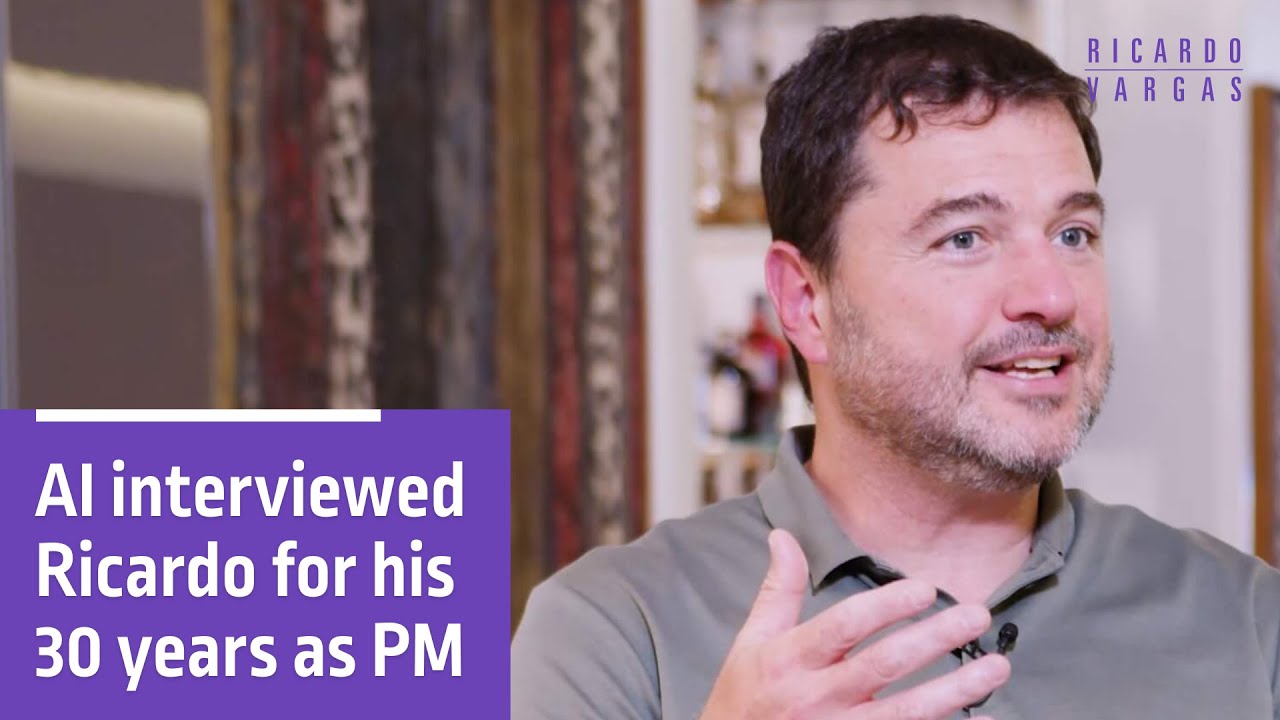
To me, this experience is a very concrete example of where we are today: not humans versus AI, but humans being challenged by AI to think more deeply about their own experience.
Seen through the lens of project management, these examples also help explain exactly what we observed in our Second Global Survey on AI in Project Management, developed together with Antonio Nieto-Rodriguez.
With insights from more than 870 professionals across 97 countries, the results show a clear shift.
Familiarity with AI in project management has doubled in just two years.
AI tools are moving from isolated experiments into mainstream adoption. The most significant gains are already happening in areas such as scheduling, risk management, and forecasting.
The value of AI is no longer hypothetical. It is visible, measurable, and increasingly expected.
Nearly half of organizations are reporting cost reductions, and many are seeing substantial financial returns.
What struck me most in the results is not just where AI is adding value, but how naturally it is becoming part of decision-making.
This mirrors exactly what we see in healthcare, education, and creative work:
Once AI proves it can support better outcomes, the conversation quickly shifts from “should we use it?” to “how do we use it well?”.
But what I find most meaningful is not just where AI is adding value, but where the real challenges are emerging.
Just like in healthcare, education, and creative work, our study shows that the main barriers are no longer technical. They are cultural and ethical.
Questions about trust, transparency, accountability, and the role of human judgment are now front and center.
This is a sign of maturity.
It tells us that AI is no longer something we are testing on the side. It is becoming embedded in how projects are planned, governed, and delivered.
Adopting AI, therefore, is not a technology decision. It is a leadership decision.
Tools can be implemented quickly, but mindsets take time to evolve.
The organizations seeing the greatest benefits are not those with the most advanced models, but those willing to rethink governance, accountability, and how humans and machines collaborate.
And so this year made one thing very clear to me.
AI is not about replacing project managers. It is about reshaping what it means to be one.
AI is incredibly powerful when it comes to data, patterns, speed, and prediction.
But projects are still human endeavors. They are shaped by uncertainty, relationships, values, and choices.
Our role is evolving toward sense-making, ethical decision-making, and leadership in environments where intelligent systems are part of the team.
Defending AI does not mean ignoring its risks. It means taking responsibility for them.
Bias, privacy, over-reliance, and ethics are not reasons to step away... they are reasons to become more competent, more intentional, and more conscious in how we use these tools.
Avoiding AI will not protect us from its impact. Understanding it might.
This time of the year, especially between Christmas and the end of December, is also when I reflect on the kinds of projects I want to work on, the impact I want to have, and how I want to position myself in a world where AI is increasingly present.
Like previous years, I keep coming back to a simple question: “What really matters?”
The challenge ahead is not learning how to use more tools, but learning how to combine human judgment with machine intelligence in a thoughtful and responsible way.
Speed without direction only gets you lost faster.
This same reflective spirit is also present in the podcast episode I released this week.
In this edition of the 5 Minutes Podcast, I do something I try to do at the end of every year: a retrospective.
Not a nostalgic one. A learning retrospective.
2025 was not a light year. It was a year of pressure.
Pressure for results.
Pressure for deadlines.
Pressure for costs.
And projects, as always, reflected the world around us.
So, in this episode, I share my reflections on what this year revealed about projects, organizations, and leadership under pressure — and what we can learn from it as we move forward.
Retrospectives are not about closing the past. They are about preparing the future.
And experience teaches us that impact matters more than productivity alone.
So, back in 2020, during a moment of great uncertainty, I created a small video series as a gift to myself, my family, and especially my daughters that it’s literally call “What really matters?”:

It was an exercise in reflection about values, choices, and what guides us when the future feels unclear.
I decided to revisit this material because I think it applies to this year as well. And, looking back now, I realize how relevant those reflections still are.
Technology evolves fast. Principles evolve slowly.
And after more than 30 years in this profession, this is the balance I value the most. Tools will change. Models will evolve. What will endure is our ability to make sound judgments, act ethically, and lead with intention in times of uncertainty.
So, my dear colleagues, as we close this year, my wish for you is simple.
May you use AI not just to be faster, but to be better.
May your projects benefit from technology without losing their human core.
And may 2026 be shaped not only by what is possible, but by what truly matters.
Wishing you and your families peaceful holidays and a wonderful end of the year.