Issue #31 - Criei meu gêmeo digital com IA
Olá a todos!
Nesta edição, compartilho uma experiência que transformou minha forma de enxergar produtividade, conhecimento e trabalho: a criação do meu próprio gêmeo digital com inteligência artificial. Mostro como treinei a IA com meus livros, artigos, palestras e métodos de trabalho e as reflexões que esse processo trouxe sobre o futuro das profissões e da gestão de projetos.
Também comento um avanço impressionante da IA na pesquisa científica, ao contribuir para a solução de um problema matemático que permaneceu em aberto por quase 80 anos, e compartilho fotos e destaques da minha participação no Congresso Brasileiro de Gerenciamento de Projetos 2026.
Além disso, apresento duas novidades importantes: o lançamento da versão em português do Fluxo de Processos do PMBOK® Guide 8ª Edição, disponível gratuitamente, e meu novo curso dedicado ao PMBOK® 8, desenvolvido para ajudar profissionais a aplicar seus conceitos de forma mais prática e conectada à realidade dos projetos.
Ricardo
In This Issue
- My Digital Twin Rewired How I See Productivity and Work
- AI Solving an 80-Year-Old Math Problem
- Photos from the Brazilian Project Management Congress 2026
- The PMBOK® Guide 8th Edition Process Flow Is Now Available in Portuguese
- New course about PMBOK8
My Digital Twin Rewired How I See Productivity and Work
Last month, on the stage of the Brazilian Project Management Congress (CBGP 2026), I did something I had never done in twenty-five years of public speaking:
I showed the audience two photos of myself, side by side, and asked which one was real. Only one of them was me. The other was AI-generated.
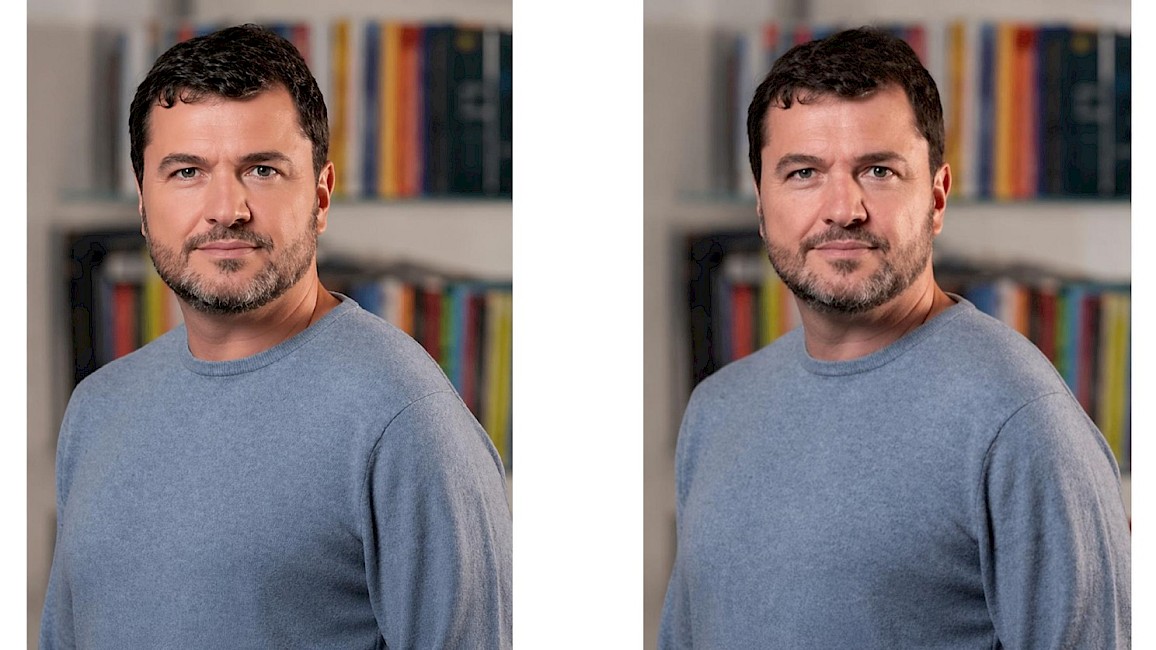
It got a laugh, and then it got the silence I was looking for.
Because the talk that followed — “AI Copilot for Projects: Redefining the Project Manager Role with Digital Twins” — was not about a photo.
It was about a much harder question: if a machine can already imitate my face, what happens when it learns to imitate my judgment, my voice, my way of solving a problem?
I have spent the last few months trying to answer that question by doing the opposite of what most people are doing.
Instead of waiting for someone to build a tool that replaces me, I sat down and built a digital twin of myself.
A version of Ricardo that lives inside Claude, trained on my CV, my books, my talks, my frameworks, my convictions, my voice. And yes, my opinions on things I refuse to comment on.
It changed me. Not in the way I expected. This edition is the report from the inside.
A few weeks before CBGP, a Yahoo Finance headline started circulating online:
“22-year-old billionaires pay professionals $2M a day to train the AI that could replace them.”
Read that again slowly.
This means that billionaires are paying experienced professionals to teach AI systems how experts think, write, decide, and solve problems, with the expectation that, eventually, some of that expertise can be automated.
For a growing generation of AI founders, your work is no longer seen only as a profession.
Your emails, your presentations, your decisions, your status reports, your judgment: all of it is becoming training data.
This is not science fiction.
A viral open-source project called colleague-skill has shown that anyone with access to your messages, documents, and chat history can package your communication style, your decision frameworks, and your work context into an interactive AI that other people can keep consulting.
So, this is no longer about preserving what someone knows. It is about preserving a usable version of how they work after they are no longer in the loop.
The real question is not whether digital twins will exist. They already do.
The question is whether yours is being built by you... or about you, without you, for someone else’s benefit.
That was the moment I decided.
If a copy of me is going to exist out there, I want it to be mine.
Trained on my real material. Bounded by my real ethics. Pointing back to me as the source of truth, not pretending to replace me.
And now is the moment when you get to this part of the newsletter and ask: but how?
At CBGP I broke this into a sequence anyone can follow. None of it requires you to be a software developer. It requires you to be honest about who you are. Let me give you the short version, the one I wish I had read before I started.
Step 1 — Define your identity
Roles, clients, countries, awards, publications. Verifiable credentials. Real projects. Real organizations. This anchors the voice in evidence — not in generalities. Without a clear identity, the twin invents authority. I fed mine my CV from Macrosolutions, my four years at UNOPS in Copenhagen directing $1.2 billion in projects, my chairmanship of PMI, the Brightline years, the 17 books. Specifics. Always specifics.
Step 2 — Document your convictions
What are the 8 to 12 things you genuinely believe after decades of work? These are the heart of the twin. They are what differentiate your answers from any generic AI. For me they include things like: strategy is worthless without delivery. Resilience is not enough — leaders must be anti-fragile. Transformation is personal, always. AI will not replace project managers — it will reshape them. Write yours down. If you cannot, you do not have a twin yet. You have a chatbot.
Step 3 — Define your voice
This is the most subtle and important work. How do you structure an argument? What phrases are yours? What phrases would you never use? I gave Claude my LinkedIn posts, transcripts of my 5 Minutes Podcast, chapters of my HBR article. I told it what I never say: no “certainly!”, no “great question”, no “at the end of the day”. The day the twin stopped sounding like an assistant and started sounding like me — that was the day it became useful.
Step 4 — Delimit the scope
Where is your authority real? Where do you redirect? Where would you be cautious even though you are an expert? Project management, portfolio strategy, risk, crisis, governance, AI applied to projects — full authority. Salary advice, legal interpretation, medical questions, partisan politics — redirect. This is what stops the twin from inventing credibility I do not have. As I wrote last month, it is dangerous to comment on what we do not know. The twin must inherit that humility.
Step 5 — Create reference materials
Separate documents for your frameworks, your real named cases, your positions on key sub-topics. The twin loads them on demand depending on the question. Mine has files for AI in project management, ESG and the Green Blindspot, humanitarian work, troubled project recovery, AHP for portfolio selection. Without these files, the twin sounds smart. With them, it sounds like me at my best, on a day I had time to prepare.
Step 6 — Calibrate and test
Ask the twin real questions. Compare with what you would actually say. Adjust the voice, correct imprecise claims, add nuance. This is not a one-time setup. It is a discipline. I still benchmark mine every couple of weeks against a question I have just answered live.
Step 7 — Install
Where will the twin live? Your computer, your team’s, your client’s, the open web? Private repo or GitHub? Who is allowed to talk to it? Understand the limitations. The twin is not me. It does not feel my mood on a hard morning. It does not know what I learned this week. It is a snapshot of how I think, not a substitute for the thinking.
I expected the twin to save me time. It did. What I did not expect is what happened to how I think about my own work. Here are the three shifts I did not see coming:
Shift 1 — Productivity stopped being about doing more
For two decades, productivity to me meant output per hour. Emails answered. Meetings finished. Books written. The twin forced a different question: what part of my work can only I do, and what part am I doing out of habit? Once you build the twin, you have to decide what it gets and what stays with you. That decision is brutal. It exposes how much of a senior professional’s day is being spent on work that has already been encoded — just not yet handed over. Real productivity, I now believe, is the ratio of what only you can do to what you actually spend your day doing. Most of us are sitting on the wrong side of that ratio.
Shift 2 — The bottleneck moved from my calendar to my clarity
For years, my limit was time. I could not be in São Paulo, Lisbon, and Riyadh in the same week. Now my twin can. It answers questions from a junior consultant in Brazil while I am asleep, prepares briefings for a client in Saudi Arabia while I am at the gym, and walks a student in Singapore through the ten principles of people-centered transformation while I am cooking on Sunday. None of that is the bottleneck anymore. The new bottleneck is whether I have been clear enough — in writing, in frameworks, in convictions — for the twin to represent me well. If I have not done the thinking, the twin cannot fake it. Generative AI is the most ruthless mirror of intellectual laziness I have ever met.
Shift 3 — My work became a system that compounds
Knowledge work, for most of us, is a stream of disposable artifacts. A deck used once. A memo read in a meeting and forgotten. A talk delivered to 1,500 people and never seen again. Building the twin forced me to treat every artifact as a permanent contribution to a system that gets better every time I add to it. For example, the 5 Minutes Podcast episode I recorded last week is not just content anymore. It is training data for the version of me that will answer a question in 2030. That changes what you write, how carefully you write it, and how seriously you take the moments most people throw away.
There is a chart I have been showing executives for almost two years: the PMI quadrant of project management tasks that move from “human-led” to “automated” over time.
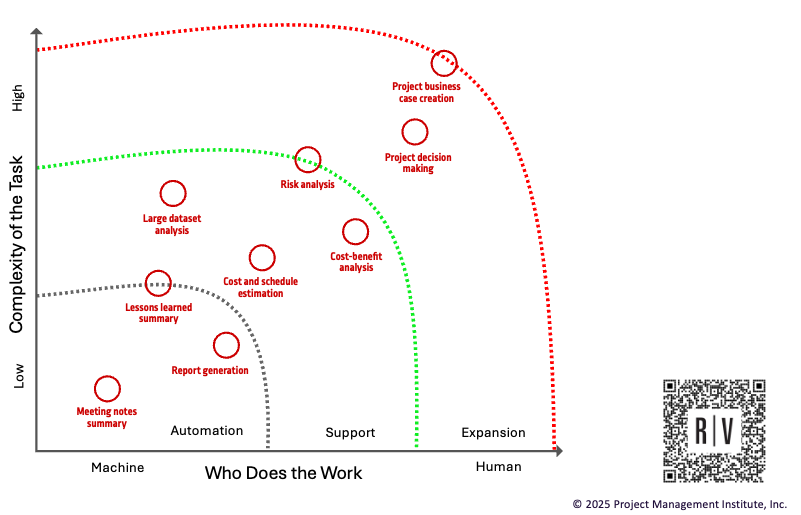
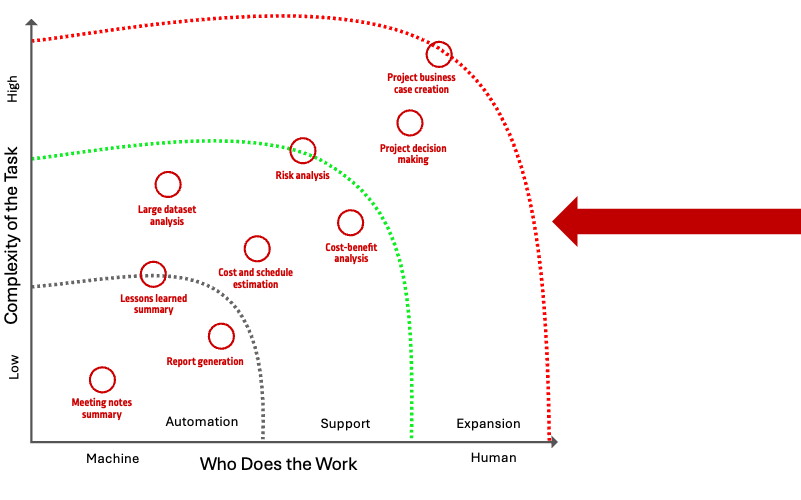
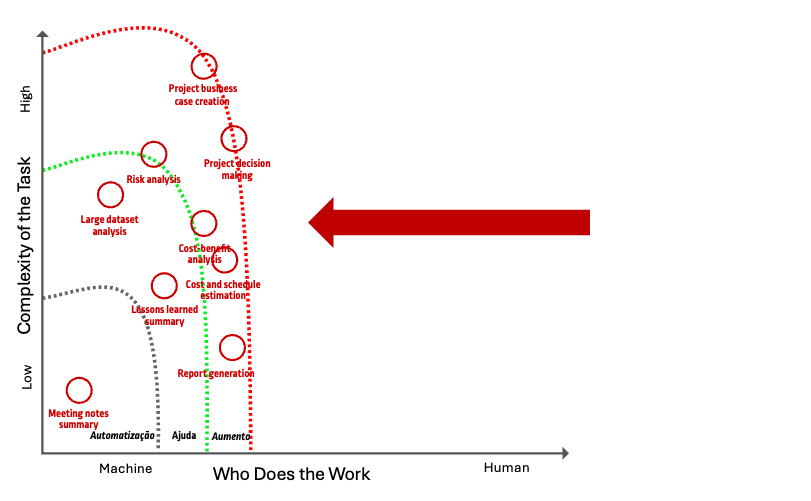
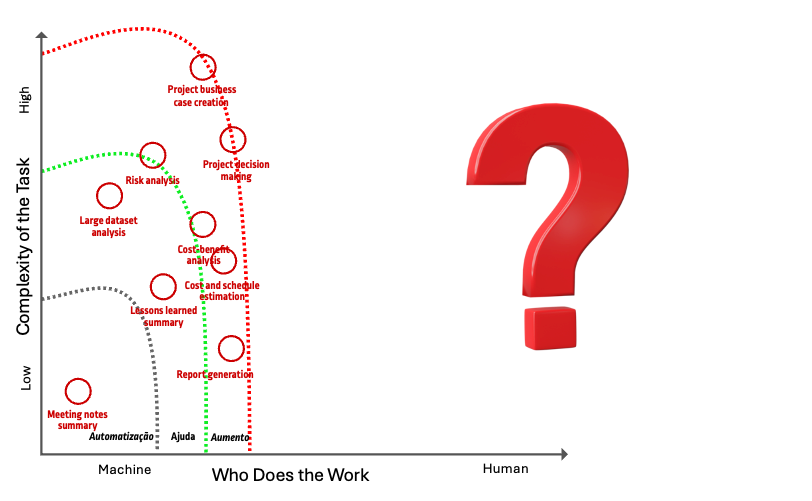
In the 2023 version, only meeting notes and report generation lived in the automated zone.
In the 2025 version, risk analysis and cost-benefit analysis have crossed the line.
By the time we are talking again next year, project business case creation and project decision making will be inside it.
Gartner’s prediction that 80% of project management tasks will be AI-run by 2030 is no longer aggressive. It is conservative.
This is not a future you can postpone. It is a future you can either shape or be shaped by.
So, the question is not whether AI will replicate parts of your job.
The question is: When that replication happens, will it be built on a faithful version of your judgment, with your name on it, under your control... or will it be a cheap caricature built from scraps of your work by someone who does not know you?
There is a reason I named the CBGP talk “AI Copilot for Projects.”
A copilot is not a replacement. A copilot extends the pilot.
But for the copilot to work, the pilot has to know what they are doing. And has to write down enough of it for the copilot to fly the easy stretches while the pilot saves attention for the storms.
That is the deal. AI is the copilot. You are still the pilot. But only if you are senior enough, clear enough, and humble enough to teach it.
Five years ago, if you had told me I would spend a weekend training a digital version of myself — and that the experience would teach me more about my own work than the last decade of executive coaching — I would have laughed.
I am not laughing anymore.
The most surprising thing about building a twin is that you do not end up with a copy. You end up with a clearer version of yourself.
The exercise forces you to admit what you really believe, what you actually know, and what you have been faking for years. In a profession built on confidence, that is a rare gift.
If you take one thing from this edition, take this: do not wait.
The professionals who start now will be the ones who shape how AI represents their work for the next decade. The ones who wait will have their work represented for them, by someone who does not know them, in a way they did not choose.
“With great power comes great responsibility.” — Stan Lee
I closed CBGP with that line. I will close this edition the same way. The power to build a digital version of yourself is here, now, on your laptop, for the price of an AI subscription.
The responsibility to do it carefully — to keep your good name and ethics intact, your humility loud — is entirely yours.
Build yours. Or become part of someone else’s model.
What Has Been on My Radar Recently?
AI Solving an 80-Year-Old Math Problem
One thing that really caught my attention recently was an announcement from OpenAI about one of its models autonomously disproving a famous mathematical conjecture that had remained unsolved for almost 80 years.
The problem, originally proposed by mathematician Paul Erdös in 1946, is considered one of the classic open questions in discrete geometry. What makes this especially fascinating is not just the result itself, but how it happened.
This was not a model specifically trained only for mathematics. It was a general-purpose reasoning model that connected ideas across distant areas of knowledge and produced a proof strong enough for verification by leading mathematicians.
To me, this is another strong signal of where AI is heading. We are moving beyond AI as a productivity tool or assistant and entering a phase in which AI begins contributing to genuinely creative and scientific work.
We are still in the early days of this transition, but moments like this make it very clear: AI is evolving much faster than most people realize.

Erdös Problem - Previously known construction of many unit distances from a rescaled square grid.
Photos from the Brazilian Project Management Congress 2026
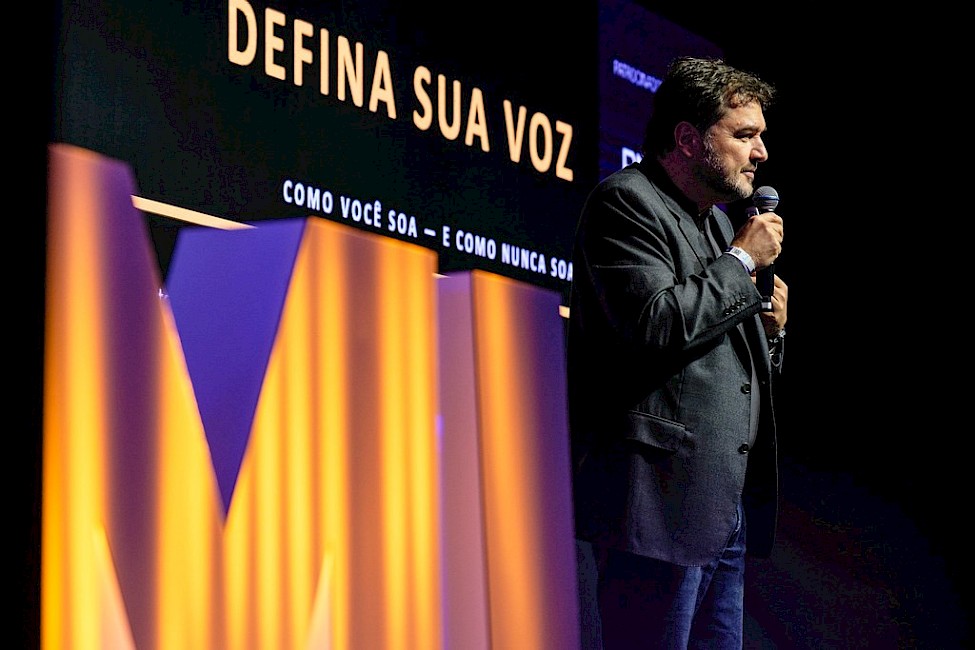
The photos from the Brazilian Project Management Congress 2026 in Rio Grande do Sul are finally available here if you’d like to check them out.
A huge thank you to everyone who attended the congress.
It is always a great pleasure for me to return to Brazil. I’m always incredibly well received, and every time I come back, I truly feel at home.
I hope you like the photos as much as I did!
Quick Announcements
New course about PMBOK®️ Guide 8th Edition
I’ve been waiting to share this with you… and it’s finally happening!
After a lot of work (and honestly, a lot of passion poured into every detail), my new course is officially LIVE: Navigating the PMBOK Guide 8th Edition: A Practical Guide For Project Leaders
This isn’t just another theory-heavy course. It’s built to help you finally connect the dots between the PMBOK®️ Guide and real project work.
If you’ve ever felt that the guide is too dense or disconnected from reality… this was built for you.
Check the course out here.
And to celebrate the launch, there’s a special offer you don’t want to miss:
With the coupon code PMBOK8, you can get a USD 100 discount on both the course and the Bundle that includes the PMBOK Guide 8th, 7th, and 6th Editions!!
That’s a significant launch discount for a limited time only.
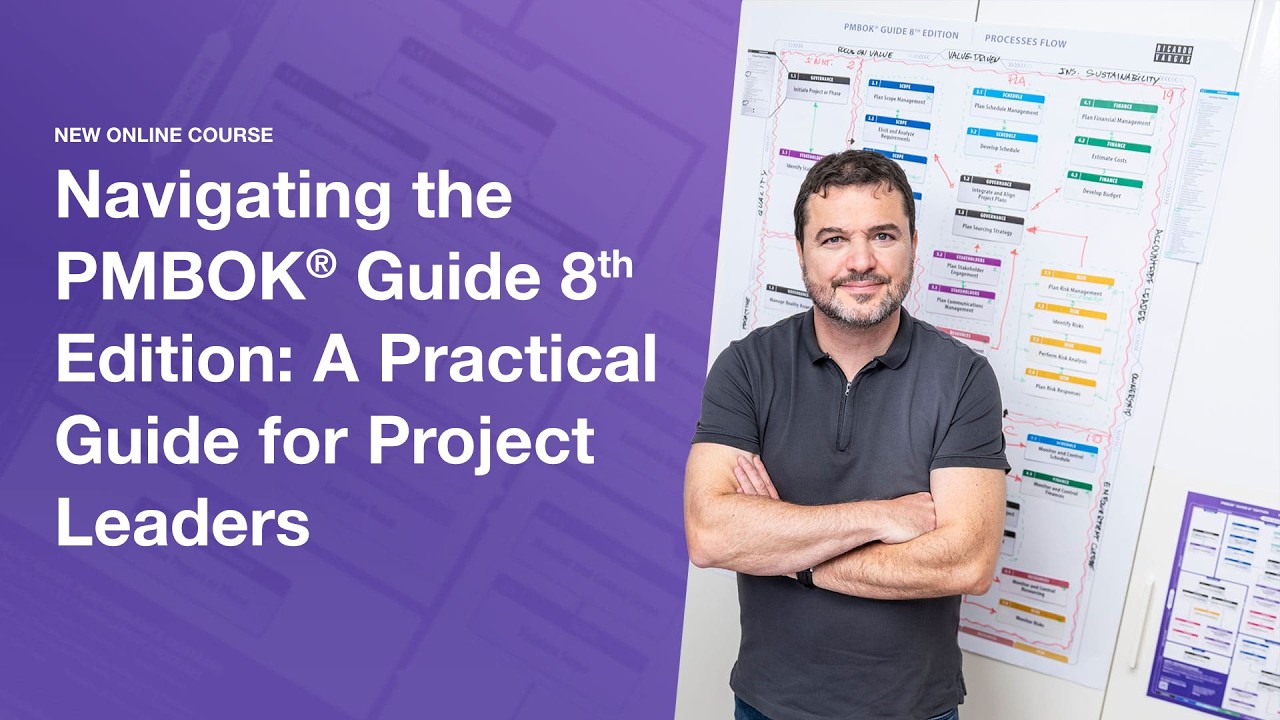
Also, I’ll be releasing 5 free lessons over the next few days across my social media (LinkedIn and Instagram) and YouTube. If you want a quick taste of the course, stay tuned because the lessons are coming soon!
I’m genuinely excited to finally share this with you, and grateful for everyone who’s been part of the journey. Hope it helps you in your projects. That’s the real goal
The PMBOK® Guide 8th Edition Process Flow Is Now Available in Portuguese
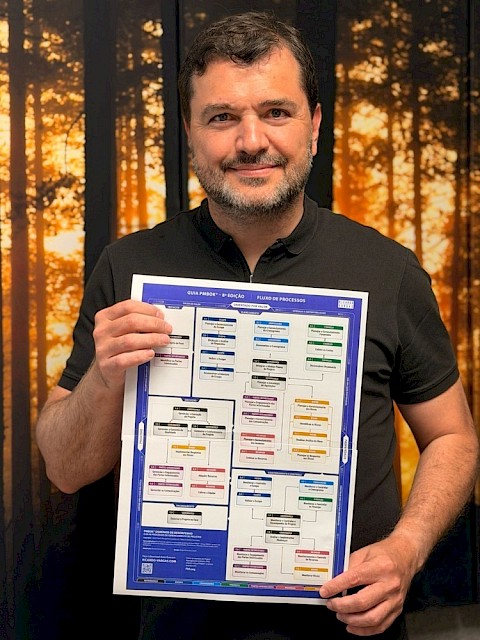
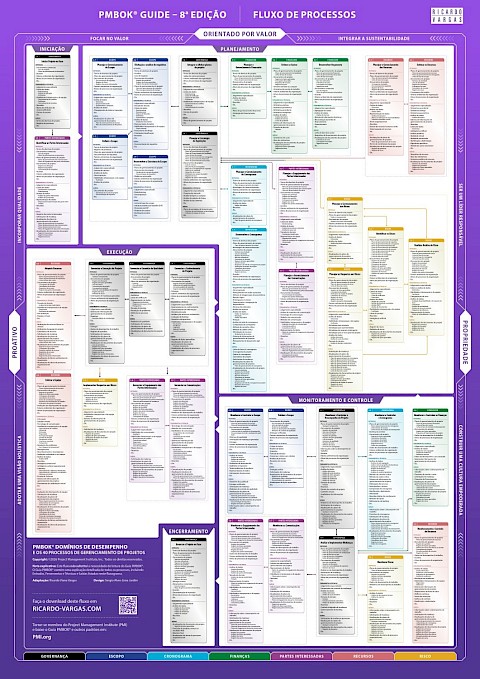
Last week, I was finally able to launch the complete PMBOK® Guide 8th Edition Process Flow in Brazilian Portuguese
The goal remains the same as always: to help project professionals better visualize and understand the processes and concepts from the guide in a more practical and connected way.
You can download it for free here
I also created step-by-step explanatory videos on YouTube:
English version.
Portuguese version.
The videos include subtitles in multiple languages, including English, Portuguese, Spanish, Arabic, Chinese, and French.
And this is only the beginning. Over the next few weeks, we’ll also be launching versions in Spanish, Chinese, Japanese, Korean, French, and German. So, stay tuned
As always, these resources were created to support your studies and help you visualize the concepts more clearly, but they do not replace the official guide available to PMI members.
I truly hope this helps you in your learning journey. We built it with a lot of care and dedication
Your Voice Matters!
You can also read the previous issues here.
If you have any suggestions, comments, or anything else that will help me make it better, please send a note to [email protected]
Please feel free to share this newsletter with your friends, colleagues, and other people you may find will benefit from it.
They can also subscribe to receive it here.
Thanks for your support, and I hope it was helpful to you.
Cheers,
Ricardo Vargas