Issue #28 - The Project Manager of 2050: Less Gantt Charts, More Diplomacy and Biology
Hey everyone!
In recent weeks, I've been reflecting on a question that goes beyond deadlines and deliverables: what kind of project manager will the world need in the coming decades? In a future shaped by accelerating technologies, new sciences, and increasingly complex systems, our role may evolve from managing constraints to fostering alignment between people, interests, and directions.
In this edition, I share reflections on this transformation and on the advancement of agentic AI tools, such as Claude Cowork, which are beginning to execute complete tasks within workflows. I also discuss the recent debate about the so-called "SaaSpocalypse" and bring insights from my participation as host of the O'Reilly GenAI Superstream, where we explored how AI agents are beginning to transform the way work is done.
At the same time, I reflect on something equally important: the skills that AI cannot yet perform. Strengthening judgment, influence, empathy, and contextual awareness may become one of the greatest differentiators for project professionals in the future.
Finally, I'm sharing news about the next edition of the AI-Driven Project Management masterclass, new courses I'm developing with LinkedIn Learning, and the launch of the AI Ambassadors program, an initiative to build a global community dedicated to the practical application of AI in project management.
I hope this edition will be an invitation to reflect not only on the next project, but on the future of our profession.
Ricardo
In This Issue
- The Project Manager of 2050: Less Gantt Charts, More Diplomacy & Biology
- Claude Cowork: When AI Stops Assisting and Starts Working
- Abilities AI Can Not Perform (Yet)!
- SaaSpocalypse or Just Market Noise?
- Hosting the O’Reilly Superstream: What Stood Out About AI Agents
- New edition of the Masterclass in March
- 12 More LinkedIn Courses on the Way
- Abilities AI Can Not Perform (Yet)!
- Introducing the AI Ambassadors Program
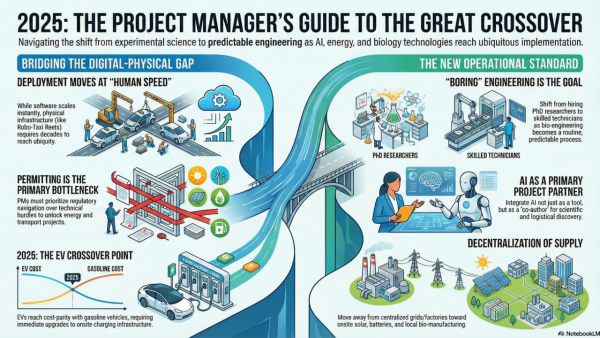
The Next-Generation Project Leader: Mastering People, Politics, and Complexity
I want to start this reflection with a question that has been sitting with me for weeks:
What if the future is not defined by crisis… but by abundance?
Every year for the past 20 years, I take time to step back and think beyond deadlines, beyond quarterly targets, beyond the noise that fills our days as project managers. This year, I pushed that reflection further than usual. Not one year ahead. Not three. But decades.
And somewhere in that process, I came across a series called Best Case Scenario, hosted by Kevin Kelly and Daniel Pink.
The conversations explore energy, bioscience, advanced materials, computing, brain science, and transportation.
What stayed with me wasn’t any single prediction. It was the pattern.
A quiet but persistent shift.
Energy becoming cheaper and more abundant. Scientific discovery accelerating beyond human-only capacity. Computing power dissolving previous limits. Biology becoming something we can increasingly design, not just observe.
Yet, if you look at the headlines, you would think the opposite is happening.
We are conditioned to see constraint. To expect disruption. To prepare for shortage.
And that matters more than we think... Because the future we assume is the future we design for.
If we assume scarcity, we build defensively. If we see abundance emerging, we start thinking differently. About scale, access, and impact.
And this is where it becomes personal for us.
Because if even part of this positive trajectory toward abundance becomes real, the role of the Project Manager will fundamentally change.
For decades, we’ve been trained to manage constraints. Time. Budget. Scope. Risk. We became experts in trade-offs.
But what happens when some of those constraints begin to loosen?
I don’t think we become less relevant. I think we become something else entirely.
In areas like biotechnology, we are slowly moving away from pure experimentation toward something closer to engineering. Today, we still ask: “Will this even work?” Tomorrow, the question may become: “How fast can we scale this?”
That’s a completely different mindset.
The bottleneck shifts: From discovery to execution. From uncertainty to distribution. From invention to coordination.
And that changes where we spend our energy.
At the same time, I’m seeing something even more interesting in large infrastructure and energy projects.
The limitation is no longer the technology. It’s alignment.
Permits. Regulation. Communities. Politics.
The real critical path is no longer the sequence of tasks: it’s the sequence of agreements.
And that’s where I believe one of the biggest shifts will happen:
We will spend less time managing plans… And more time managing people, expectations, and trust.
Fewer Gantt charts. More diplomacy.
And I believe that AI will accelerate this transition even further. Just not in the way many fear.
Not as a replacement, but as a partner.
We’re already moving beyond AI as a tool that answers questions. It’s becoming something that helps us think. That helps us see patterns earlier. That supports decisions in real time.
Imagine walking into a complex stakeholder negotiation with an AI agent that has already mapped influence dynamics, identified potential conflicts, and suggested communication strategies tailored to each person in the room.
Imagine detecting team burnout before it becomes visible. Or simulating the second-order effects of a decision before committing to it.
That doesn’t remove the human element. It raises the bar for it.
Because when information becomes abundant, and intelligence is always available, what differentiates us is no longer what we know.
It’s how we judge. How we relate. How we lead.
The Project Manager of 2050 will not be hired simply to protect the budget. They will be hired to ensure direction.
And then there is another layer that we don’t talk about enough: speed.
The future will not move at one pace.
Infrastructure will still take decades. Cities will evolve over generations. But software—and increasingly AI-driven systems—will iterate in months, sometimes weeks.
As Project Managers, we will be asked to synchronize these different speeds. To connect 50-year decisions with 6-month cycles.
That’s not just coordination. That’s systems thinking at a completely different level.
And, looking at all of this, one idea keeps coming back to me:
For most of the last century, Project Management has been the discipline of scarcity. But if the coming decades bring even partial abundance—energy, intelligence, biological capability—then our role flips.
The constraint is no longer resources.
It’s human alignment.
Fear. Resistance. Misunderstanding. Lack of shared direction.
And in that world, the Project Manager is no longer just protecting the plan. We are protecting the intention.
We are there to ensure that progress actually leads somewhere meaningful.
I’m not naïve about the future.
There will still be instability. There will still be uncertainty. There will still be moments where everything feels fragile.
But one thing became very clear to me during this reflection: If we only prepare for things to go wrong, we will miss what could go right. And if we only prepare for abundance, we risk ignoring real constraints.
So maybe the real challenge is not choosing one perspective over the other. Maybe it’s holding both.
Designing for resilience while being ready to scale.
Because in a world that is accelerating this fast, the greatest risk is no longer running out of resources. It’s moving quickly in the wrong direction.
And that, more than any tool, any framework, or any methodology... Is where I believe our role truly begins.
What Has Been on My Radar Recently?
Claude Cowork: When AI Stops Assisting and Starts Working
A few days ago, I released a YouTube video of my 5 Minutes Podcast about this topic, and I simply had to bring it here to the newsletter as well.
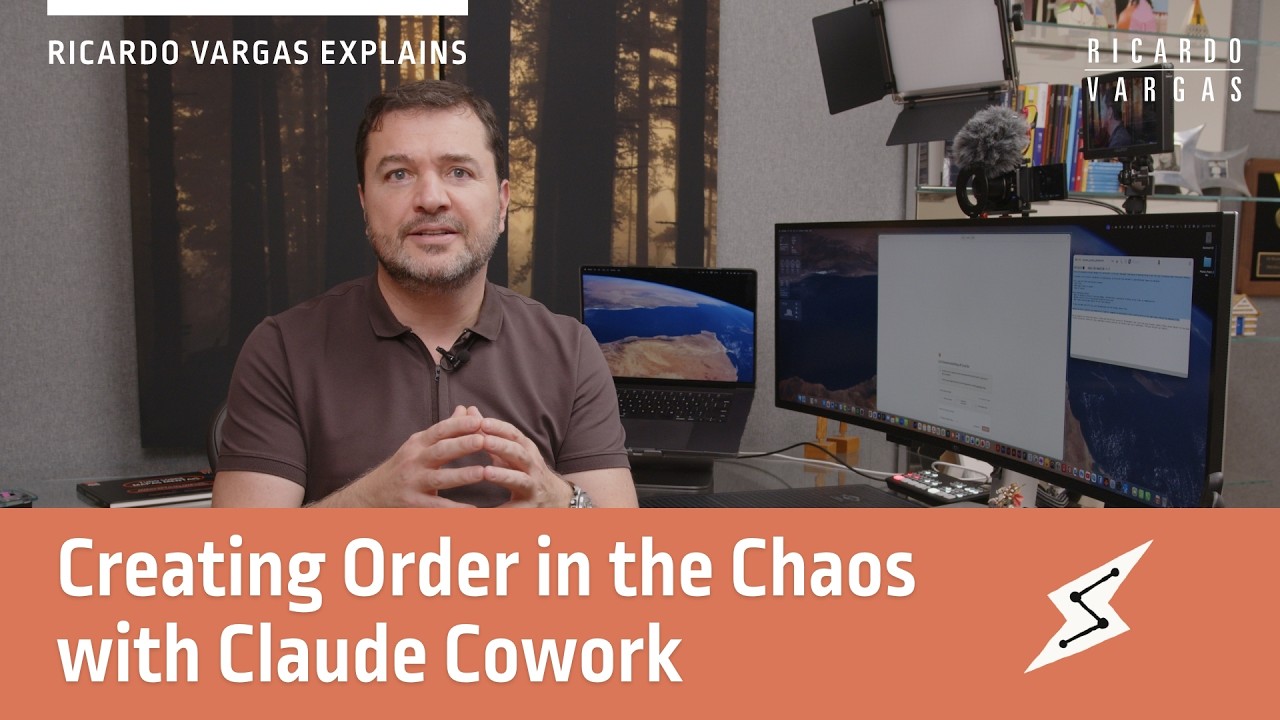
Claude Cowork is an agentic AI model from Anthropic that goes far beyond traditional conversational assistants. It’s built to execute complete tasks within real contexts: files, folders, documents, reports, and workflows.
What impressed me the most was its applicability to Project Management and structured knowledge work.
A huge portion of our time is spent on operational tasks: organizing documents, consolidating data, reviewing information, and preparing reports.
By delegating that work to an AI agent that can actually plan and execute, we can shift our focus from execution to orchestration, decision-making, and strategy.
Again, this is coming from someone with no affiliation to Anthropic, ok? Just a genuinely satisfied user.
I strongly recommend you test Claude Cowork and experience firsthand what agentic AI can do for your projects, PMOs, and organizations.
Abilities AI Can Not Perform (Yet)!
For the past several months, I’ve been wrestling with a question that is becoming unavoidable for all of us: Where does human capability end, and where does artificial intelligence capability begin?
Some people look at AI with concern, others with excitement, and many with curiosity.
Instead of focusing only on what AI is becoming capable of doing, I decided to reflect on something different: which abilities remain deeply, fundamentally human.
Over the past months, I identified 30 capabilities that, in my judgment, AI still cannot truly perform — and these are precisely the skills where I am intentionally investing more of my own development.
As a chemical engineer, I organized them as a kind of “Periodic Table of Human Abilities” , grouping them into six dimensions:
- Judgment and Decision-Making
- Influence and Communication
- Emotional Connection
- Contextual and Social Awareness
- Human Essence and Growth
- Adaptability and Creativity
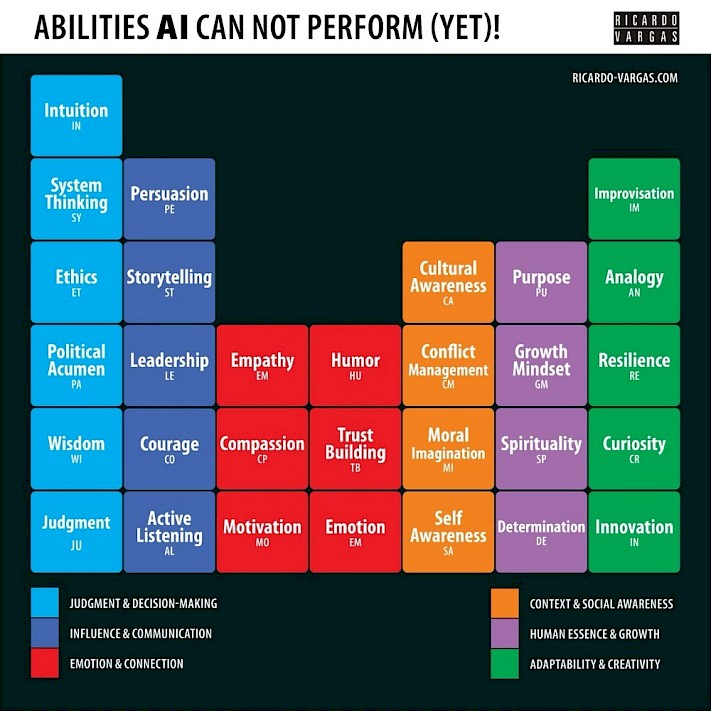
The more powerful technology becomes, the clearer one idea feels to me: our future advantage will not come from competing with machines, but from strengthening what makes us human.
Do you agree with these capabilities?
Is there any skill you believe is missing — or any that you think AI may start replicating sooner than we expect?
SaaSpocalypse or Just Market Noise?
A topic that really caught my attention this week: what some are already calling the “SaaSpocalypse”.
After Anthropic released new AI capabilities around its Claude Cowork agent, the market reaction was immediate... And strong. We’re talking about more than $280 billion wiped out across software and SaaS (Software as a Service) stocks in just a few days.
Companies like Salesforce, Thomson Reuters, and LegalZoom were among the most affected, as investors started questioning something fundamental:
What happens when AI agents start doing what software used to sell as features?
And this is where it gets interesting.
Because tools like Claude Cowork are not just “helping” anymore. They’re executing workflows end-to-end: legal research, data analysis, reporting, Customer Relationship Management (CRM) interactions
All things that have been the core of SaaS products for years.
So naturally, the market panicked.
But is this panic justified?
You have leaders like Jensen Huang from Nvidia calling this reaction “illogical”, arguing that AI will enhance software, not replace it.
And honestly, I see both sides.
On the one hand, I don’t think companies will suddenly abandon decades of systems, data, and infrastructure. That’s just not how enterprises work.
On the other hand, after testing these new agentic tools myself, I can clearly see why the market reacted as it did.
Because this feels different.
This is the first time that I genuinely feel that:
- AI is not just a layer on top of software
- It’s starting to replace entire workflows
And if your SaaS product is essentially a bundle of workflows… that’s where the risk is.
Personally, I don’t see a “SaaS apocalypse”. But I do see a massive shift in how value is created in software.
The winners?
Probably the ones who integrate AI deeply into their products, own unique and high-quality data, and become part of critical workflows (not just nice-to-have tools).
Everyone else… Might feel real pressure.
This is definitely a space I’ll be watching closely, because this isn’t just market noise.
It’s a signal.
Hosting the O’Reilly Superstream: What Stood Out About AI Agents
Last month, I had the chance to host GenAI Superstream: Agentic Workflows for Enhanced Productivity and Project Success, and the core theme was clear:
We are moving from “generative AI that helps you think and draft” to agentic “AI that can execute work when you give it goals, context, tools, and guardrails”.
Across the sessions, we kept coming back to “AI fluency” as a practical skill for project managers, not a trend to watch from the sidelines.
A major highlight was seeing AI orchestration and workflows in action.
Zapier showed how AI can connect work across thousands of apps and turn conversations into automated follow-ups, with a strong warning about avoiding “AI slop” by feeding tools the right context.
N8N reinforced the same direction with live builds of agentic workflows, including a simple but powerful evaluation lens for automation: time saved, feasibility, and propensity for damage
We also explored the rise of the “AI Chief of Staff” concept through Fellow AI, with demonstrations around meeting intelligence, email classification, and turning transcripts into decision support and operational insight.
On the delivery side, Claude Code stood out for its ability to bring order to messy project documentation, detect contradictions, extract action items, and help create a single source of truth without heavy engineering effort.
Finally, the stream offered a forward-looking perspective on what changes first in project work: routine status updates become automated, while humans focus more on framing problems, making tradeoffs, and driving outcomes.
Tools like Gemini in Google Workspace and Jira Rovo showed what this looks like in practice, from smarter email and spreadsheet analysis to stronger backlog quality and story shaping, while still emphasizing the need for governance and guardrails as adoption scales.
It was truly a pleasure for me to be part of this event and to learn so much from all the speakers involved.
Quick Announcements
New edition of the Masterclass in March
Together with Antonio Nieto-Rodriguez, I’m excited to remind you about the 10th edition of the AI-Driven Project Management Masterclass.
This is a hands-on, real-world experience showing how AI is already transforming the way we lead projects, programs, and portfolios.
In two dynamic 4-hour sessions on March 24 and 25, 2026 (10:00 AM–2:00 PM ETC / 14:00–18:00 WET), participants will engage in interactive group studies and practical exercises designed to level up skills in AI-driven Project Management.
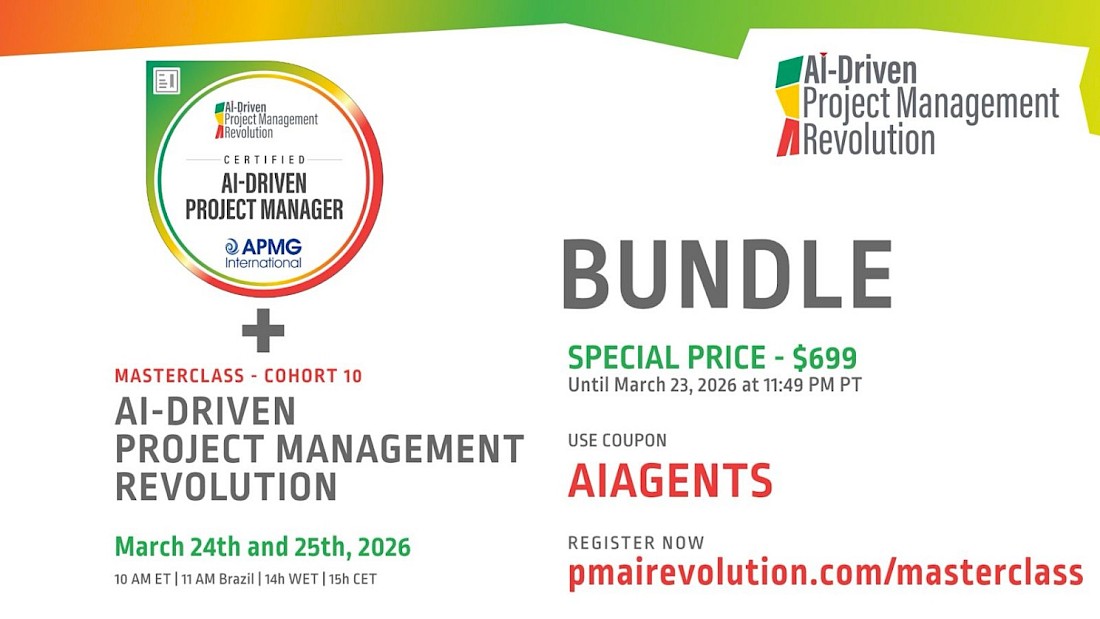
Also, we have a very special discount: you can have a Bundle of the Certification and the Masterclass for the special price of $699. Just need to use the code AIAGENTS on the checkout.
Over 500 professionals from 63 countries have already joined previous editions, making this a unique opportunity to learn, apply, and connect with peers at the forefront of AI innovation in Project Management.
This masterclass is for anyone ready to streamline, enhance, and revolutionize their approach to projects using AI. You can know more, here.
12 More LinkedIn Courses on the Way
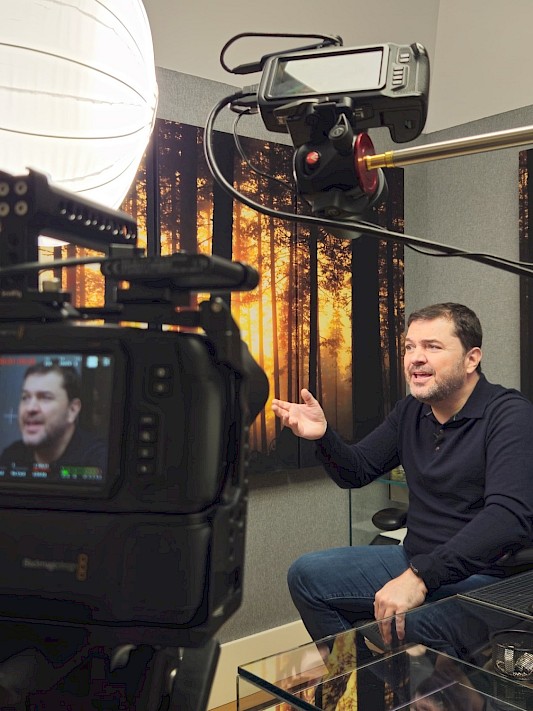
Lately, I’ve been spending a lot of time in the studio working on something I’m really excited about: new courses in collaboration with LinkedIn Learning, both with the Brazil and US teams.
Over the next few months, I’ll be releasing 12 new courses focused on Project Management and AI. Everything is already in production, and all of them are planned to go live this semester. It’s been an intense (and very rewarding) process, especially seeing how fast this space is evolving and translating that into practical content.
If you’ve been following my work, you know I’ve been building content around this space for a while now. Over the past few years, I’ve created several courses to help professionals navigate Project Management, innovation, and AI in a practical way.
As I shared in the previous edition of this newsletter, here are some of the courses that are already available:
- How to Keep Your Team on the Bleeding Edge of AI Innovation
A framework for leaders to build sustainable AI strategies by aligning people, processes, and technology.
Introducing the AI Ambassadors Program
Over the last few years, Antonio Nieto-Rodriguez and I have spent a lot of time exploring how AI is changing Project Management.
For almost 3 years, we’ve been hosting monthly webinars together.
What started as a simple experiment has grown into a truly global community, with people joining from every region of the world, asking sharp questions, sharing real experiences, and pushing the boundaries of our profession.
And that’s exactly why we believe it’s time for the next step.
We want to open the space to the community itself.
We are exploring creating a group of AI Project Management Ambassadors: around 20–30 volunteers worldwide who want to help us grow this initiative beyond just Antonio and me.
This is not a commercial role. This is not about selling certifications.
It’s about creating space to:
- Facilitate regional and global conversations
- Share real demos and lessons learned
- Exchange best practices and hands-on AI use cases
- Expand the dialogue across regions and industries we simply can’t reach alone
Ultimately, it’s about building a genuine, global community around the practical application of AI in Project Management.
Antonio and I only have 24 hours in a day, but this initiative requires more than two people—it requires a community.
So instead of centralizing everything, we want to multiply the impact by creating ambassadors and initiatives across the world.
If this resonates with you, send us an email at [email protected]
Tell us:
- Why you’d like to be involved
- How do you think you could contribute (demos, AI workflows, implementation, facilitation, etc)
- Where you’re based, as we aim to build a regional presence
We don’t have all the answers yet… And that’s exactly the point.
This is an experiment. A learning journey. Something we want to co-create together.
Let’s stop watching the future happen.
Let’s build it as a community.
Your Voice Matters!
You can also read the previous issues here.
If you have any suggestions, comments, or anything else that will help me make it better, please send a note to [email protected]
Please feel free to share this newsletter with your friends, colleagues, and other people you may find will benefit from it.
They can also subscribe to receive it here.
Thanks for your support, and I hope it was helpful to you.
Cheers,
Ricardo Vargas