Publications

PM World Journal
Addison, Texas, USA – November 2026

The Planning Break-Even Point: When More Planning Stops Paying Off

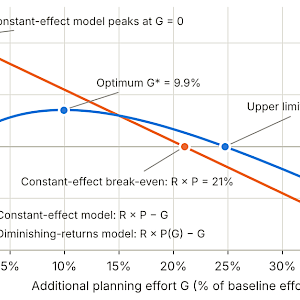
How much effort should a project invest in planning? Too little causes rework, while too much wastes resources. This paper develops a quantitative model to identify the optimal balance, incorporating diminishing returns to derive the optimal planning effort and its limits. Two illustrative cases, a software development project and an electrical substation, use deterministic calculations, sensitivity analysis and Monte Carlo simulation. Results show that optimal planning represents 7% to 10% of baseline effort, reducing labour costs by 7% to 11%, while excessive planning can destroy value.

Publications

London School of Economics Business Review (Adapted Version)
London - United Kingdom – November 2026

Employees Have No Incentive to Disclose How Productive AI Makes Them

AI can create significant productivity gains that remain invisible to organizations.
The challenge is not only measuring these gains, but creating an environment where employees feel safe to disclose them.
Learn why individual productivity metrics can discourage transparency, and how disclosure-safe measurement can change the game.
The future of AI productivity depends as much on trust as it does on technology.

Publications

Morgan State Project Management Magazine - Spring 2026
Baltimore, Maryland, USA

Artificial Intelligence, Infrastructure, and Systemic Risk: Why Scaling Demands Project Management Maturity

In this article, Ricardo Vargas  and João Jacinto examine how the AI debate is shifting from technology to governance, investment, infrastructure, and risk management. Drawing on project management principles from the PMBOK® Guide, they argue that sustainable competitive advantage in AI will depend less on enthusiasm and more on disciplined governance, portfolio management, and strategic execution. Oracle is cited as an example of the operational and financial pressures created by large-scale AI investments.

Publications

IBGC Horizontes
São Paulo - Brazil – March 2025

Between Opportunity and Collapse: Building an Inclusive and Responsible Future with AI

In this article published by IBCG Horizontes, Ricardo Vargas explores how artificial intelligence reshapes decision-making within organizations, bringing to light both transformative opportunities and profound ethical risks. Using real-world examples—such as the use of AI at Itaú Unibanco and in Salesforce's executive meetings—he discusses governance challenges, the need to upskill board members, and possible paths toward this technology's ethical, inclusive, and responsible adoption—a compelling reflection on the human role in an increasingly automated future.

Publications

Driving Sustainable Innovation
Thinkers50 - London - United Kingdom – July 2024

London School of Economics Business Review (Adapted Version)
London - United Kingdom – August 2024

On the Way to Save the World, Don’t Forget to Check Your Green Blindspot

​​​​​​Ricardo Viana Vargas and Antonio Nieto-Rodriguez discuss leveraging AI and technology to effectively address all ESG components after the World Economic Forum (WEF) published a report on the progress made in encouraging private companies to adopt firm metrics on environmental, social, and governance (ESG) initiatives, a week before the Davos 2024 summit.

Publications

London School of Economics Business Review (Adapted Version)
London - United Kingdom – May 2024

Institute of Project Management (Adapted Version)
London - United Kingdom – July 2024

PM World Journal (Adapted Version)
Dallas - USA – August 2024

Beyond Algorithms: The Impact of Emotional AI on Corporate Culture

Artificial emotional intelligence promises to revolutionise the way companies do business. With it, robots will be able to understand, react to and mimic human emotions. Ricardo Viana Vargas and André Barcaui discuss how the technology will affect healthcare, the workplace and personal relationships.

Publications

Harvard Business Review
Cambridge – United States – October2023

The Opportunities at the Intersection of AI, Sustainability, and Project Management

There are unprecedented opportunities at the intersection of AI, project management, and sustainability. Unfortunately, without proper execution, projects to implement AI come with complexities, costs and a carbon footprint that undermine sustainability goals. It is essential for project managers to learn to implement “green algorithms,” specialized AI constructs designed to both enhance operational efficiency and prioritize sustainability. A five-step framework of defining sustainability objectives, centralizing data, customizing algorithms, pilot testing, and full-scale implementation can guide project managers and leaders as they deploy green algorithms effectively.

Publications

Project - The official journal of the Association for Project Management (APM)
London - Association of Project Management – July 2023

AI: Beyond the Buzzword

As a senior project sponsor, you oversee a complex portfolio of projects with a combined budget exceeding $50 million. One of these is a high-stakes transformation project to modernize your company's production facilities. As you sit down for the weekly status update meeting, you're greeted by an AI-driven bot. It seamlessly synthesizes information from multiple projects into actionable insights, providing a clear snapshot of your entire project portfolio.

Publications

The Digital Transformation Playbook - What You Need to Know and Do
Thinkers50 - London - United Kingdom – June 2023

London School of Economics Business Review (Adapted Version)
London - United Kingdom – July 2023

Are You Willing and Ready to Embrace AI?

When it comes to artificial intelligence (AI), project leaders should ask themselves two key questions. First: Are my organization and I willing to adopt AI-inspired tools as part of the ordinary course of doing business, particularly in project management? This question will give you a sense of your organization’s appetite for adopting machine learning (ML)–inspired technology. The second—and, in fact, the more critical question—is: Are my organization and I ready to take this important leap forward? This question will give you a sense of how quickly you can identify and apply AI to projects.

Publications

Duke University Dialogue Review
Durham - United States, June 2023

Leading Projects in an AI-Powered World

Technology has begun to transform how organizations deliver projects, and rapid change lies ahead. What role will leaders play when AI is deployed in project management?

While AI is not yet a standard tool in the world of projects and project management, there is no doubt that it will disrupt this discipline, and probably faster than we expect. The prospect of that transformation seems almost incredible: in most organizations the tools used to manage projects remain relatively basic compared to the sophisticated digital technology being deployed in other parts of business. Most projects are still managed with Microsoft Office tools, such as Excel and PowerPoint. Can you imagine running your business and operations with spreadsheets? Well, that reflects how little technology has evolved in project management.

Search in Articles
Section Statistics
50
Published articles
6
Available translations
Latest podcast episodes
Book recommendations

Read Ricardo's reviews of some of the best technical books published.

View recommendations Powered by Goodreads.com logo