Issue #29 - Fasten Your Seatbelts: The Sponsor Is Gon
Hey everyone!
In this edition, I draw attention to an often invisible risk in projects: the silent loss of the sponsor. In “Fasten Your Seatbelts: The Sponsor Is Gone,” I show how the absence of active leadership doesn't generate immediate failures, but weakens decisions, alignment, and project progress over time.
The newsletter also addresses the role of artificial intelligence in current work. On the one hand, it reinforces human capabilities that AI does not yet replace—such as judgment and influence. On the other hand, it offers a relevant insight: AI is not reducing work, but making it more intense and demanding.
In the final highlights, there is the new date for the free webinar with Antonio Nieto-Rodriguez, as well as an advance announcement of a complete course on the PMBOK® Guide 8th Edition, aimed at making its application more practical and accessible.
Ricardo

In This Issue
- When Leadership Quietly Leaves the Room
- Abilities AI cannot Perform Yet
- AI Isn’t Replacing Jobs. It’s Making Us Work Harder.
- New Webinar Date
- New PMBOK8 Course Coming Very Soon
When Leadership Quietly Leaves the Cockpit
There is a moment in many projects that rarely appears on dashboards, status reports, or steering committees.
Nothing has officially failed.
No milestone has been missed.
No red flag has been raised.
And yet, something essential is no longer there. The sponsor has disappeared.
Not always in a visible way. Sometimes they were promoted, sometimes they moved on to something more urgent, sometimes they are still formally assigned to the project but no longer show up with energy, urgency, or influence. Their name remains in the structure, but their presence does not.
This is one of the most underestimated risks in project management.
We spend time discussing scope, budget, timelines, stakeholders, and technical complexity. And all of that matters.
But there is a quieter risk that often goes unnoticed until it is too late: the slow erosion of executive sponsorship.
When that happens, projects do not collapse. They drift.
Decisions take longer than they should. Escalations stop producing outcomes. Tensions between teams remain unresolved. Competing priorities begin to take over.
The work continues, but something changes in the way it moves.
The project is still active, but it is no longer being actively led.
Sponsorship was never meant to be ceremonial.
Many organizations still treat the sponsor as a symbolic role. Someone who approves the budget, appears at kickoff, and occasionally asks for updates. But real sponsorship is not a formality. It is an active leadership responsibility.
A true sponsor does at least three things that no process, methodology, or tool can replace.
First, they give the project legitimacy. They signal to the organization that this initiative matters and deserves attention.
Second, they remove barriers. When priorities collide, when decisions stall, when political friction emerges between functions, the sponsor uses authority to unblock the path.
Third, they protect momentum. In every project, energy declines over time. New urgencies appear. Interest shifts. Attention fragments. The sponsor helps maintain focus when the rest of the organization starts looking elsewhere.
Without that support, even strong teams become vulnerable.
Not immediately, not dramatically, but progressively.
What makes this situation dangerous is how subtle it is.
A missing sponsor does not always create immediate chaos. More often, it creates ambiguity.
The team starts compensating. The project manager spends more time negotiating than leading.
Meetings increase, documentation expands, and communication intensifies. It feels like control, but it is often just a reaction to something deeper that is missing.
Eventually, the project loses something harder to recover than a schedule: it loses trust.
Because the real issue is not a flaw in the process. It is power.
A project without an engaged sponsor is a project without enough weight behind it.
And when that happens, no amount of tracking or reporting can fully compensate. Activity remains high, but progress weakens.
The team looks busy, but the project is quietly losing altitude.
You can usually sense it before you can prove it.
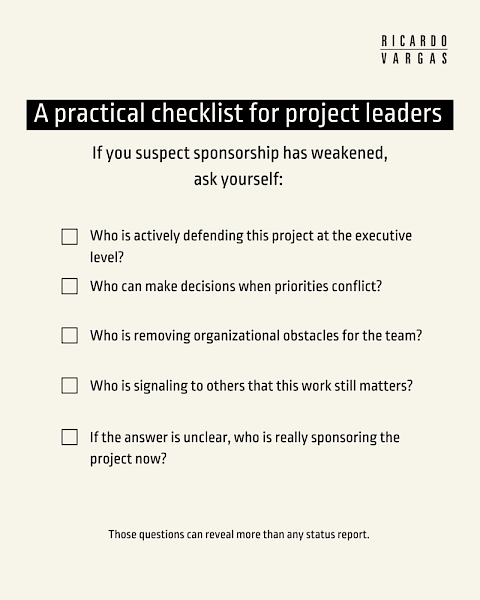
Watch for patterns like these:
- The sponsor stops attending key meetings or repeatedly delegates them.
- Escalated issues remain unresolved for too long.
- Strategic decisions are postponed or redirected without clarity.
- Other leaders begin openly challenging the project, and no one steps in.
- The sponsor no longer refers to the project in executive conversations.
- The team becomes uncertain about priorities, trade-offs, or political support.
- The project manager starts relying on influence alone, where authority is required.
One missed meeting is not the problem. One delayed answer is not the problem. None of these signals alone is decisive.
The problem is the pattern. Together they form a pattern that is hard to ignore.
At that point, the instinct is often to push harder on execution, to tighten control, to increase visibility.
But that response, while natural, often misses the point. The problem is not that the team is doing less. The problem is that the project is no longer being carried out at the level where it needs to be defended.
Recognizing this early changes the conversation. This is not a moment for denial. It is a moment for diagnosis and action.
What to do when this happens:
1. Name the problem early
Do not confuse nominal sponsorship with active sponsorship. A name on the org chart is not enough. If the sponsor is no longer involved in decision-making, conflict resolution, and visible support, the project poses a governance risk.
2. Treat it as a formal project risk
Loss of sponsor engagement should be identified explicitly, not whispered informally. Describe the impact on decision speed, stakeholder alignment, prioritization, and delivery confidence. Once the risk is visible, it becomes easier to address with seriousness.
3. Separate symptoms from cause
If the team is experiencing delays, indecision, or stakeholder resistance, ask whether these are execution problems or sponsorship problems. Many teams try to solve governance failures with better coordination. That is often the wrong diagnosis.
4. Re-engage with precision
Do not go back to the sponsor with vague frustration. Go with specifics:
- which decisions are stalled,
- what barriers require executive intervention,
- what trade-offs need sponsorship,
- and what is at risk if support does not return.
The more concrete the request, the easier it is to make the problem visible.
5. Clarify sponsorship expectations
Sometimes sponsors do not disappear out of neglect, but out of ambiguity. They may not fully understand what the role requires after kickoff. Reconfirm what is expected: visibility, decision support, conflict resolution, and sustained executive advocacy.
6. Build a secondary support network
A project should never depend entirely on one individual. Strengthen the coalition around the initiative. Identify adjacent executives, influential stakeholders, and operational allies who can help maintain momentum while sponsorship is being rebuilt.
7. Escalate governance, not emotion
If the sponsor has effectively stepped away, this may require formal reassignment or redefinition of executive ownership. That conversation must be conducted calmly and in a structured manner. This is not about blame. It is about ensuring that a strategic initiative still has leadership behind it.
8. Reassess the project honestly
If no real sponsor can be re-established, then a harder question must be asked: should the project continue in its current form? An unsupported project may consume time, energy, and credibility without a realistic path to success.
It shifts the focus from delivery mechanics to leadership presence.
It forces a more uncomfortable question: who is actually backing this initiative now, in real terms, not just on paper?
Because a name in a document is not the same as someone actively making space for the project to succeed.
If that question does not have a clear answer, the risk is already real.
Projects in this state tend to continue just enough to appear alive, while slowly losing the conditions that would allow them to succeed.
One of the great illusions in project management is that projects fail only because of poor planning, weak execution, or technical mistakes.
But, in the end, many projects do not fail because teams are incapable or plans are flawed.
Many fail for a simpler reason: at a critical moment, leadership's attention shifted elsewhere and never fully returned.
The team keeps moving forward, but without direction, protection, or real backing.
A project can survive complexity, pressure, and even mistakes. What rarely survives is the quiet absence of leadership.
Because once that disappears, the project may still be flying, but no one is truly navigating.
What Has Been on My Radar Recently?
Abilities AI cannot Perform Yet
For the past several months, I’ve been wrestling with a question that is becoming unavoidable for all of us: Where does human capability end, and where does artificial intelligence capability begin?
Some people look at AI with concern, others with excitement, and many with curiosity.
Instead of focusing only on what AI is becoming capable of doing, I decided to reflect on something different: which abilities remain deeply, fundamentally human.
Over the past months, I identified 30 capabilities that, in my judgment, AI still cannot truly perform — and these are precisely the skills where I am intentionally investing more of my own development.
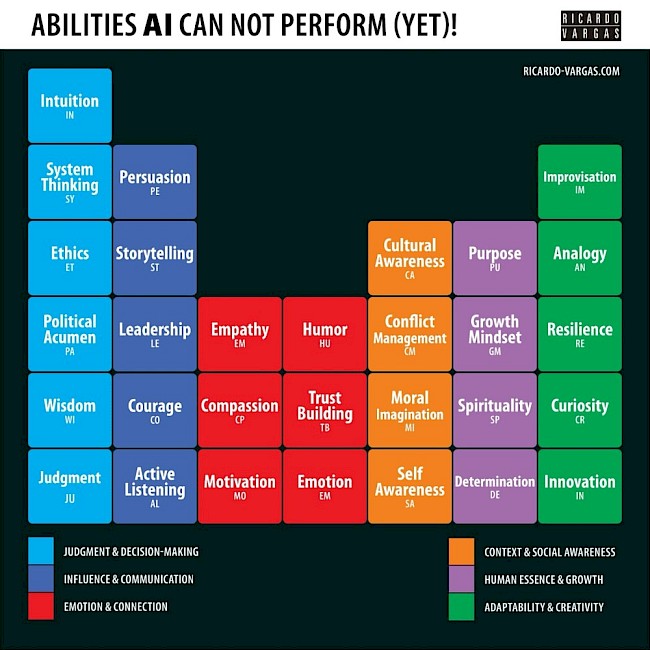
As a chemical engineer, I organized them as a kind of “Periodic Table of Human Abilities” , grouping them into six dimensions:
- Judgment and Decision-Making
- Influence and communication
- Emotional Connection
- Contextual and Social Awareness
- Human Essence and Growth
- Adaptability and Creativity
The more powerful technology becomes, the clearer one idea feels to me:
Our future advantage will not come from competing with machines, but from strengthening what makes us human.
AI Isn’t Replacing Jobs. It’s Making Us Work Harder.
I came across a recent article from Forbes that challenges one of the most common questions I get almost daily: “Do you think AI will make jobs disappear?”
According to new research, the answer — at least for now — is no. Instead of reducing work, AI seems to be intensifying it.
Data from ActivTrak shows that after adopting AI, employees spend significantly more time on emails, messaging, collaboration, and multitasking. Work is becoming faster, denser, and more complex. Even weekends are no longer safe, with noticeable increases in work hours.
Studies, including one discussed by researchers from the UC Berkeley Haas School of Business and Harvard Business Review, suggest that when AI tools enter workflows, people don’t work less... they take on more.
The takeaway? AI isn’t removing the need for humans... It’s raising the bar. The real challenge isn’t job loss, but adapting to a world where productivity comes with higher intensity and, potentially, greater burnout.
So, as I have been saying for a long time, the better question is not “if” AI will replace jobs, but “how” it will reshape the way we work.
Quick Announcements
New Webinar Date
I just wanted to share a quick update on our next webinar: The session we had planned for April 3rd will now take place on April 10th.
Antonio Nieto-Rodriguez and I will be hosting it, and as always, it will be 100% free and open to anyone who wants to learn, exchange ideas, and stay current.
It’s a relaxed, free-flowing conversation about AI in Project Management. Each month, more than 3,000 professionals join us, which turns it into something more than a typical webinar — a space for honest discussion around trends, tools, concerns, and what’s really shaping the future.
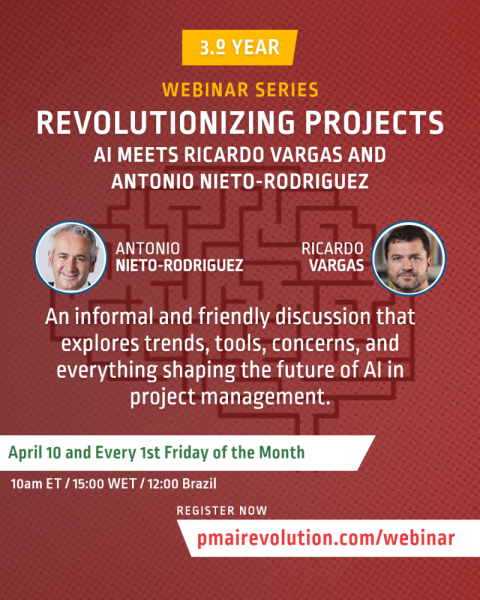
April 10th - Register here.
New PMBOK8 Course coming very soon
I still remember when I was starting my career, studying the early versions of the PMBOK Guide. Back then, projects were mostly about delivering on time, on budget, and within scope. It was very operational, very execution focused.
Things have changed.
Today, the conversation has shifted. It’s no longer just about delivering outputs. It’s about delivering value.
At the end of last year, the PMBOK® Guide 8th Edition was released, continuing that evolution. And when I went through it, I felt the need to break it down and make it practical for others.
So, I recorded a full explanation on YouTube: English and Portuguese
Later, I also created something I wish I had when I was studying: a complete Process Flow for the PMBOK® Guide 8th Edition. It’s entirely my work and completely free. You can download it here.
Now, I’m taking it one step further.
I’m currently building a full, intensive course focused entirely on the PMBOK® Guide 8th Edition. A deep and structured walkthrough of the guide, designed especially for those preparing for PMI certifications.
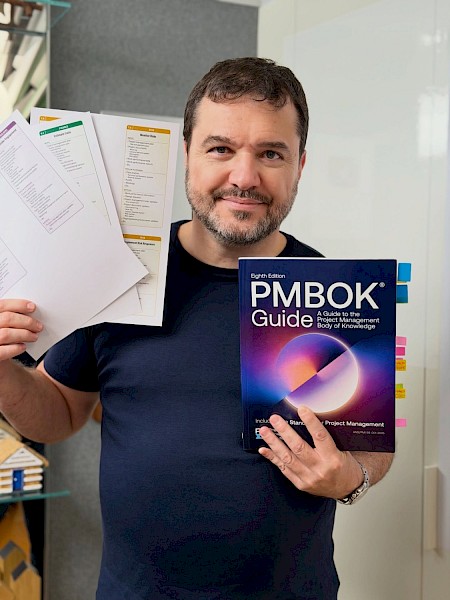
It’s coming very very soon. If you’re interested, stay close. I’ll be sharing updates on my social channels:
Your Voice Matters!
You can also read the previous issues here.
If you have any suggestions, comments, or anything else that will help me make it better, please send a note to [email protected]
Please feel free to share this newsletter with your friends, colleagues, and other people you may find will benefit from it.
They can also subscribe to receive it here.
Thanks for your support, and I hope it was helpful to you.
Cheers,
Ricardo Vargas