Issue #30 - The Danger of the Uninformed Opinion
Hey everyone!
In this edition, I reflect on the risks of opinions without real knowledge. In “The Danger of Uninformed Opinion,” I address the concept of “situational humility” and show how superficial opinions, often amplified by influence and social networks, can impact decisions, teams, and projects.
The newsletter also highlights current trends in AI, including the strategy of S&P 500 companies for adopting artificial intelligence and the characteristics of the “AI-generated fruit soap operas” that went viral on social media, prompting reflection on attention, overstimulation, and decision-making.
Another highlight is the presentation of my “digital twin” at the Brazilian project management congress, showing how AI agents can expand knowledge and support management.
Finally, the edition announces the new class of the AI in Projects Masterclass with Antonio Nieto-Rodriguez and recommends the book *The Project Management AI Handbook*, focused on the practical application of AI in project management.
Ricardo

In This Issue
- The Danger of the Uninformed Opinion
- S&P 500 AI Strategy
- The AI Fruit Novelas Taking Over TikTok
- The 21st Brazilian Project Management Congress and My Digital Twin
- Masterclass & Certification Bundle
- The New Date of our Next Monthly AI Webinar
- Book recommendation “The Project Management AI Handbook”
It Is Dangerous to Comment About Something We Don’t Know
Today’s newsletter is a little different.
I’m going to look back and reflect on an episode of my 5 Minutes Podcast that I recorded in 2023.
At the time, the episode focused specifically on influencers and the need for a “place of speech” where individuals speak from a position of knowledge.
But what started as a reaction to the influencer economy ended up sitting on a principle I have been writing about for years — situational humility — and on something I see inside project management every single week.
So instead of letting a five-minute audio do all the work, I wanted to expand on it here, in writing, where I can be more careful. Because being careful, it turns out, is the entire point.
Let me start by setting the scene.
I spent five years at the United Nations (UNOPS) in Copenhagen, directing projects in more than 120 countries.
During my time at the UN, I experienced a diversity of unique travel experiences. I flew into Tel Aviv, drove through the West Bank, crossed into Gaza, sat in refugee camps in Zaatari (Jordan), visited Saudi Arabia and Iraq, and walked through places most people cannot locate on a map.
I talked to ministers, to field teams, to mothers, to children, to soldiers, to NGO workers, to engineers, to UN humanitarian staff on some of the worst days of their lives.
And here is what I want to tell you:
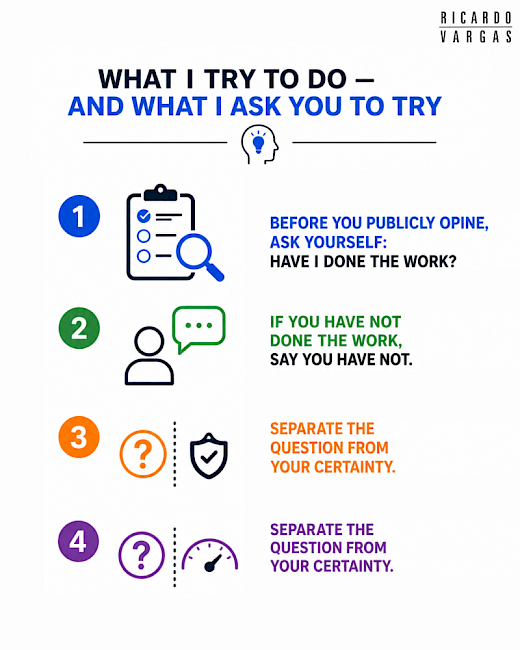
- Before you publicly opine, ask yourself: have I done the work? - Have I read the primary sources, spoken to people with lived experience, sat with the data long enough to have earned a view?
- If you have not done the work, say you have not. - A thoughtful “I do not know enough to have a firm view on this yet” is one of the most credible sentences any leader can speak.
- Separate the question from your certainty. - You can still discuss. You can still explore. You can still ask questions. What changes is the tone — from delivering verdicts to exploring the terrain.
- Reward the people in your team who say “I do not know.” - Push back on the ones who pretend. Over time, that single move will change the quality of every decision your organization makes.
This is not about silencing anyone.
It is about reclaiming the difference between an opinion and a verdict, between speaking and knowing, between being loud and being right.
The question is not whether we have the freedom to comment on anything, because the vast majority of us do.
The question is whether our comments are earning their place in the world or just adding noise.
Noise to a system already drowning in it.
What Has Been on My Radar Recently?
S&P 500 AI Strategy
A new report from CB Insights offers one of the clearest snapshots yet of how S&P 500 companies are operationalizing AI, and the takeaway isn’t just that adoption is rising. It’s that the shape of competition is becoming more defined.
Nearly 70% of index constituents are now active in AI, but influence is far from evenly distributed. Microsoft, Amazon, Alphabet, and Salesforce account for roughly a third of all AI activity.
Partnerships with startups are rising fast (1,000+ in 2025), but most are still about ecosystem positioning rather than direct revenue.
Investment continues to favor infrastructure—foundation models, tooling, and inference—over end-user applications, signaling the stack is still forming from the bottom up.
At the same time, governance and control are becoming central. As AI moves into production, monitoring and safety are shifting from compliance issues to core competitive capabilities.
What does this mean? That we’re entering a phase where AI advantage is less about who has access to models, and more about who can integrate, govern, and scale them effectively.
The gap between “AI-enabled” and “AI-native” organizations will likely widen. Not because of technology availability, but because of execution discipline.
In short, the AI race is no longer just about building capability. It’s about owning the system around it.
The AI Fruit Novelas Taking Over TikTok
I don't know if you heard of these videos before. I had not until now.
My daughters (Ana and Gabriela, both in their twenties) were the ones who showed them to me.
I don’t have an active TikTok account, and I’m not planning to have one, but I ended up watching a few clips out of curiosity.
What I saw was AI-generated fruit characters — with names like “Moranguete” and “Abacatudo” —acting out fast-paced, hyper-dramatic relationship storylines.
Here’s a YouTube video that you can watch in Portuguese or switch the audio to English to see what it’s about:

At first glance, it feels like pure nonsense entertainment.
But the more you watch, the clearer the design becomes: constant novelty, emotional escalation, and unpredictability, all optimized to keep attention locked in.
This is part of a broader category of content that is increasingly being described as “brain rot”: low-complexity, high-stimulation media that prioritizes engagement over meaning.
The point is not depth or narrative coherence, but retention. You don’t necessarily “follow” it... You are pulled through it.
And that distinction matters.
Because what’s interesting here is not the fruit characters themselves, but what they represent about how attention is being shaped online.
We are moving toward formats that are faster, more fragmented, and more emotionally reactive. Content is no longer just consumed. It is continuously interrupted, accelerated, and replaced.
Over time, that starts to influence expectations outside of entertainment as well.
In environments like project management, for example, similar patterns can emerge:
constant notifications, rapid-fire updates, fragmented communication, and a pressure to always be reacting.
When everything becomes urgent, very little becomes reflective.
You start to see subtle but important shifts:
- decisions made with less context because speed is prioritized over understanding
- reduced tolerance for ambiguity or long-term planning
- an increasing preference for visible activity over meaningful progress
- and a gradual erosion of sustained attention on complex problems
The concern is not the content itself. It is the cognitive conditioning it reinforces.
And the real challenge is not avoiding these formats entirely but making sure they don’t become the default way we process everything.
We must also consume content that requires patience to watch and contains, structure and depth to broaden critical thinking.
The 21st Brazilian Project Management Congress and My Digital Twin
I recently had the incredible opportunity to participate in the Brazilian conference of project management and leadership. It is truly amazing to witness firsthand how Artificial Intelligence is completely reshaping the way we approach and think about project management.
During the event, I delivered a presentation titled "AI Copilot for projects: Redefining the Project Manager’s Role with Digital Twins”.
A major highlight of my talk was a live demonstration of an AI Digital Twin I created of myself. Using Claude Cowork, I fed the AI my entire knowledge base—all my books, articles, and frameworks.
The result?
An agent capable of answering questions on my behalf, capturing not just my knowledge, but my specific tone of voice and speech patterns.
In the presentation, I outlined the 7 steps to create your own digital twin:
Step 1: Define your identity, including verifiable credentials and real projects.
Step 2: Document your genuine convictions and proprietary frameworks.
Step 3: Define your voice, characteristic phrases, and argument structures.
Step 4: Delimit the scope of your actual authority and set ethical limits.
Step 5: Create reference materials based on real cases and key sub-themes.
Step 6: Calibrate and test the AI using real benchmark questions.
Step 7: Install the digital twin locally or host it as a skill for your team to use.
This is not just a neat trick; it is a massive new trend. You can use this technology for risk management, portfolio management, or even to create a digital version of yourself to scale your expertise. While AI handles automation and report generation, it still requires our unique human intuition, ethics, and leadership abilities that AI cannot perform “yet” (and I hope not for a long time J).
I encourage you to watch my recent YouTube Short about this experience:

Don't wait—start experimenting with AI today. Anticipate these trends and combine technological mastery with exceptional human capabilities.
Quick Announcements
Masterclass & Certification Bundle
I’m excited to share some very good news about our AI in Project Management Masterclass.
We are releasing the 11th edition of our AI-Driven Project Management Masterclass, co-led with Antonio Nieto-Rodriguez.
Dates: July 1 and 2, 2026
Time: 10:00 AM – 02:00 PM CET (14:00 – 18:00 WET)
This is a highly interactive, practical program focused on how AI is transforming project, program and portfolio management—and how to apply it directly in real-world environments, not just at a conceptual level.
We also have a special Bundle offer available, which includes:
- Masterclass access
- Certification preparation material
- Certification exam + badge
The price is $699 USD (down from $849) if you use the code AGI before May 30, 2026 (11:59 PM PT).
More than 500 professionals from 63 countries have participated in previous editions, creating a strong global learning community focused on AI-driven project delivery.
Book recommendation “The Project Management AI Handbook”
This week, I received my copy of “The Project Management AI Handbook” from my dear friend and PMI Fellow colleague Prasad S. Kodukula.
And you know that I only recommend things that I like and truly believe in.
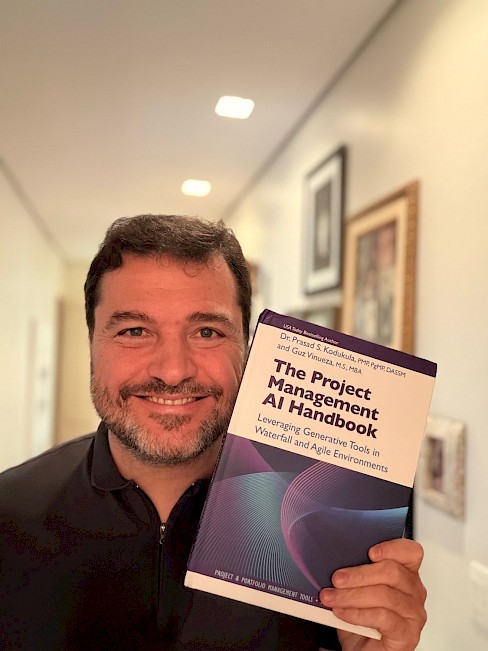
Written in partnership with Guz Vinueza, the book puts AI at the center as the most disruptive force shaping the future of project management. It brings a rich set of practical use cases and clear, step-by-step guidance to help project managers embed generative AI into their day-to-day work.
It is a timely and highly relevant contribution for anyone navigating the intersection of projects and emerging technologies. I truly hope you like it!
Your Voice Matters!
You can also read the previous issues here.
If you have any suggestions, comments, or anything else that will help me make it better, please send a note to [email protected]
Please feel free to share this newsletter with your friends, colleagues, and other people you may find will benefit from it.
They can also subscribe to receive it here.
Thanks for your support, and I hope it was helpful to you.
Cheers,
Ricardo Vargas