Issue #33 - Will You Still Have a Job as a Project Manager in 2030?
Hey everyone!
In this edition, I share some thoughts on the future of project management in the age of artificial intelligence and present three scenarios that could profoundly transform how professionals work by 2030. Beyond just discussing technology, I invite you to consider where true human value will continue to lie.
I also share my perspective on the rise of Chinese AI—specifically Kimi—and the evolution of ChatGPT into a new way of working based on delegation. Plus, I cover highlights from AI Community Day and updates on my LinkedIn Learning courses: the AI-Driven Project Management Masterclass and the AIPM certification.
I hope this edition inspires you to reflect on how to evolve alongside artificial intelligence and prepare for the future of our profession.
Ricardo

In This Issue
- Three Possible Futures for Project Managers in the Age of AI
- Is China's Kimi AI the Next Big Wake-Up Call?
- ChatGPT Is No Longer Just a Chatbot
- AI Community Day: The Future of AI in Project Management
- 350,000 Learners on LinkedIn Learning... Thank You!
- Registration Is Now Open for AI-Driven Project Management Masterclass
- The AIPM Certification Has Just Been Updated
Three Possible Futures for Project Managers in the Age of AI
If you are a project manager, program manager, PMO professional, or someone whose job is to make projects happen, I have a question for you:
Will your job still exist in 2030?
I am not asking whether projects will exist.
They certainly will.
Actually, the Project Management Institute estimates that the world may need up to 30 million additional project professionals by 2035.
Because we will probably have more projects than ever before:
We are transforming our energy systems. Building new infrastructure. Implementing artificial intelligence. Reinventing healthcare. Responding to climate change. Creating entirely new businesses, products, and technologies.
Someone — or something — will need to turn all these ideas into reality.
My question is different.
Will organizations still need you to do it?
This is a much more uncomfortable question.
I have been working with projects for more than three decades. When I took my PMP exam in 1999, project management was a completely different profession.
We spent enormous amounts of time building schedules, preparing reports, updating spreadsheets, consolidating data, organizing meetings, and asking people about the status of their work.
Many of these activities are already being automated. Gartner, for example, has predicted that by 2030, 80% of traditional project management tasks could be run by AI.
And we are just getting started.
So, what happens next?
I don’t know. Nobody knows.
But I can see at least three possible futures for people like us.
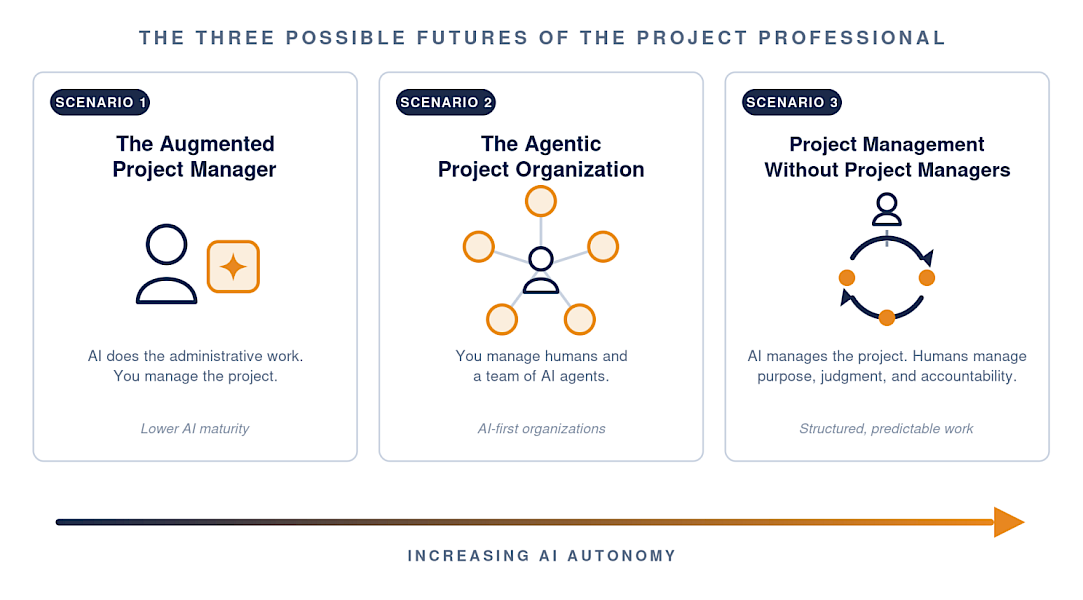
Scenario 1: The Augmented Project Manager
AI Does the Administrative Work. You Manage the Project.
This is probably the future most project managers imagine today.
You continue being the project manager. But you have AI working alongside you.
AI prepares your reports. AI updates your schedule. AI summarizes your meetings. AI identifies potential risks. AI predicts possible delays. AI consolidates information coming from your team.
Imagine arriving at work on Monday morning. Instead of spending hours asking people what happened last week, your AI assistant has already analyzed the project.
It tells you: Three activities are likely to be delayed. One supplier is showing early signs of problems. Two critical resources may become overloaded in the next three weeks. And the project has a 62% probability of missing the next major milestone unless something changes.
You did not prepare any of this. AI did. And your job starts from there. You analyze. You challenge. You decide. You negotiate. You act.
This is a very different profession. The project manager does not disappear. The administrative project manager does.
If this scenario becomes dominant, AI will not replace the project manager. It will replace a significant portion of what the project manager does today.
Because if most of the value you provide today comes from preparing reports, updating schedules, and organizing status meetings, you should pay attention.
Your job may still exist in 2030. But your current work may not.
Scenario 2: The Agentic Project Organization
You Don’t Just Use AI. You Manage AI.
Now let’s move one step further.
Imagine that instead of having one AI assistant, you have an entire digital project team.
You have a Risk Agent continuously monitoring internal and external risks. A Schedule Agent analyzing dependencies and updating forecasts. A Financial Agent predicting overruns. A Stakeholder Agent identifying possible engagement problems. A Knowledge Agent maintaining the entire memory of the project.
These agents do not simply give you answers. They execute work. They communicate with each other. They act within boundaries you establish. And they escalate decisions when human judgment is required.
In this world, your role changes again. You are no longer managing every activity. You are managing an intelligent system that manages activities.
Microsoft has used the expression “agent boss” to describe this emerging role: someone who builds, delegates to, and manages AI agents.
Think about the implications. Today, a project manager may coordinate the work of ten, twenty, or fifty people. Tomorrow, the same project manager may coordinate humans and dozens of specialized AI agents simultaneously.
And this creates another uncomfortable question.
If one highly capable project manager supported by AI agents can manage what previously required several people, what happens to the others?
The mathematics of our profession may change.
The same is true for PMOs.
Imagine a PMO today with ten people spending a significant part of their time consolidating information, preparing dashboards, checking compliance, and producing management reports.
What happens when AI agents can perform most of these activities continuously, 24 hours a day? Does the PMO disappear?
I don’t think so. But the PMO may become something completely different.
Instead of being primarily an information consolidation and governance function, the PMO could become a strategic intelligence function.
A smaller team could focus on portfolio decisions, strategic alignment, and interventions in the projects that truly need human attention.
In this scenario, the successful project professional of 2030 may not be the person who creates the best schedule or the most sophisticated dashboard, but the person who knows how to orchestrate the best combination of humans and artificial intelligence to deliver results.
The project manager of 2030 may manage fewer tasks and more intelligence.
Scenario 3: Project Management Without Project Managers
AI Manages the Project. Humans Manage Purpose, Judgment, and Accountability.
Now we arrive at the most radical scenario. And probably the most uncomfortable one.
What if some projects no longer need a dedicated project manager at all?
Imagine this.
An organization defines an objective. An AI system decomposes it into deliverables. It creates the project structure. It identifies dependencies. It estimates duration and costs. It allocates resources. It coordinates AI agents and humans. It monitors execution and adjusts the plan. It communicates with stakeholders. And it escalates only the decisions that require human intervention.
Why would every project need a dedicated project manager?
This does not mean project management disappears.
Actually, I believe exactly the opposite may happen. Project management may become more important precisely when project managers become less visible.
The discipline remains. Planning remains. Risk management remains. Stakeholder management remains. Decision-making remains.
But some of these activities may be performed autonomously.
We already have many examples of professions where the activity survived while human participation changed completely.
We still book flights and hotels, but most of us don’t call a travel agent.
The need remained. The intermediary changed. Could something similar happen to project management?
For projects that are relatively predictable, structured, repetitive, digital, and rich in data, I believe the answer is yes.
But there is another side to this.
The more uncertain the project becomes, the more important human capabilities may become.
Politics. Negotiation. Conflict. Ethics. Leadership. Ambiguity. Purpose. Trust. Accountability.
Making a difficult decision when every available option is bad. Understanding what somebody is not saying. Walking into a room and realizing that the problem described in the project report is not the real problem.
These capabilities are very different from operational tasks such as updating a Gantt chart. And as AI takes over this administrative work, they will become increasingly valuable.
This brings us to one of the most interesting contradictions facing our profession today.
Remember the number I mentioned at the beginning? According to PMI, the world could face a talent gap of up to 30 million project professionals by 2035.
At the same time, artificial intelligence is becoming increasingly capable of performing activities traditionally associated with project management.
Both things can be true.
And this creates what I call the Project Management Paradox:
We may need more project management than ever before. But we may need fewer people doing project management the way we do it today.
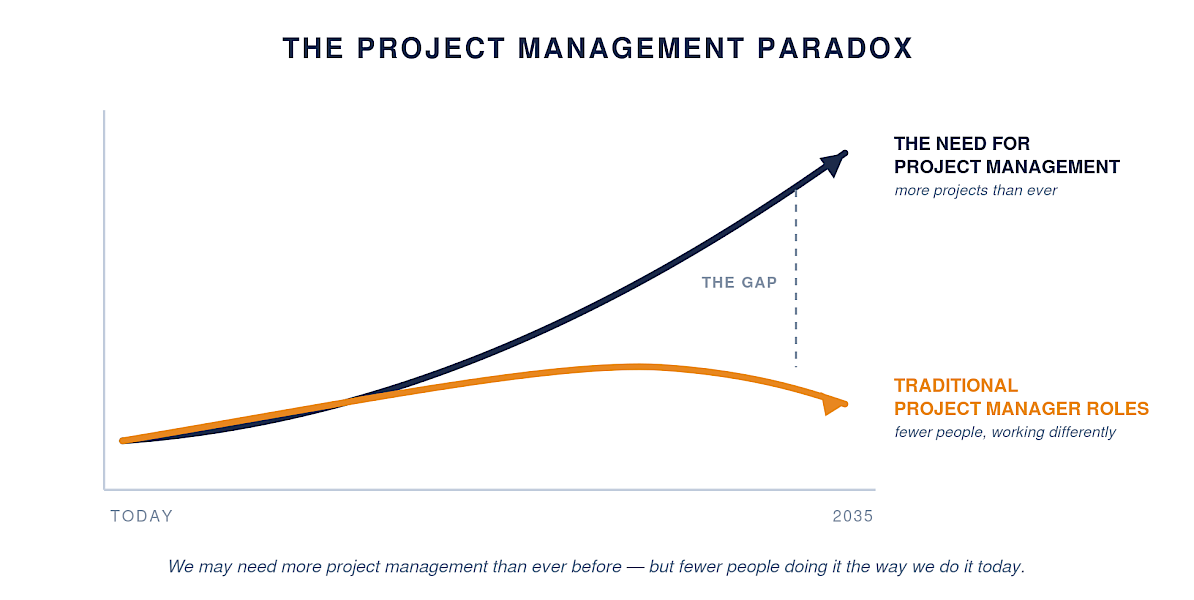
The profession may grow while some roles disappear. And different organizations will experience this transformation at completely different speeds.
So, you may be asking yourself: “Which future will happen?”
My answer is simple. All three. At the same time.
In organizations with lower AI maturity, we will see Scenario 1: The Augmented Project Manager.
In AI-first organizations, we will increasingly see Scenario 2: The Agentic Project Organization.
And in highly structured and predictable environments, we may begin to see Scenario 3: Project Management Without Project Managers.
The future of project management will not be one single future.
It will depend on the industry. It will depend on regulation. It will depend on organizational maturity. And, most importantly, it will depend on the nature of the work you do.
The more your work is structured, repetitive, predictable, and based on processing information, the greater the potential for automation.
The more your work involves ambiguity, complexity, leadership, strategic judgment, human relationships, and uncertainty, the greater the potential for human value.
And this is where I believe the future of the profession becomes very personal.
If you are a project manager or PMO professional today, I would ask you to do a very simple exercise.
Look at everything you did last week. Not your job description. What you actually did.
How much of your time was spent collecting information? How much was spent preparing reports? Updating schedules? Consolidating data? Following up on tasks?
Now ask yourself:
How much of this could an AI agent eventually do?
Be brutally realistic.
Then look at the rest of your time.
How much was spent making difficult decisions? Resolving conflicts? Negotiating? Connecting projects to strategy? Managing uncertainty? Creating trust? Deciding which projects should not be done?
This second group is where I would invest my energy.
Because the future project professional will probably not be paid primarily for knowing what is happening in the project. AI will know that.
You will be paid for knowing: What does this mean? Why does it matter? What should we do about it?
And perhaps most importantly: What should we do when there is no obvious answer?
I don’t believe project managers will disappear. And I don’t believe PMOs will disappear. But I do believe both will go through one of the largest transformations in their history.
Some jobs will disappear. Some roles will become dramatically more productive. Some entirely new roles will emerge.
The project manager of 2030 may not look much like the project manager of today.
And that is okay. Professions evolve. The danger is not evolution. The danger is standing still while everything around us changes.
So, if you work in project management today, I would not spend too much time asking: “Will AI replace project managers?”
I would ask a much more personal question: “Will AI replace what I do?”
Look at your calendar. Look at your tasks. Look at where you create value.
If your value comes primarily from collecting status information, updating schedules, and preparing reports, I believe the next few years may be uncomfortable.
But if your value comes from judgment, leadership, negotiation, strategic thinking, managing uncertainty, building trust, and making things happen when nobody knows exactly what to do, I believe your future may be brighter than ever.
AI will not replace every project manager. But it may replace many of the things project managers are paid to do today.
And ultimately, the question that matters most for your career is not whether project management has a future. It does.
The question is:
Do you have a future in project management?
The answer may depend much more on what you decide to do today than on what AI will be capable of doing in 2030.
If there is one message I hope you take away from this edition, it is that project management is not disappearing. It is evolving.
That is one of the reasons why I recently created the course: Navigating the PMBOK® Guide 8th Edition: A Practical Guide for Project Leaders.
The new PMBOK® Guide reflects this evolution, bringing together principles, focus areas, performance domains, and processes into a practical framework for leading projects in predictive, agile, hybrid, and increasingly AI-enabled environments.
If you want to understand not only what has changed, but also what those changes mean for the way we lead projects, I believe you'll find the course valuable.
What Has Been on My Radar Recently?
Is China's Kimi AI the Next Big Wake-Up Call?
While much of the AI conversation has been dominated by OpenAI, Anthropic, and Google, a Chinese company called Moonshot AI has just released Kimi K3. And it is attracting a remarkable amount of attention.
Early benchmarks suggest the model is competitive with the best frontier systems available today, approaching the capabilities of Anthropic's most advanced models in several domains while being released as an open-weight model.
What caught my attention is not just the model itself. It is what it represents.
Only a short time ago, many people assumed that the United States would maintain a comfortable lead in frontier AI.
That assumption is becoming much harder to defend.
The gap between the leading American and Chinese models appears to be narrowing faster than many expected, and competition is no longer driven only by performance, but also by openness, cost, and speed of innovation.
Whether Kimi ultimately proves to be better than GPT or Claude is almost beside the point.
The important signal is that frontier AI is no longer a race with just a handful of players. It has become a truly global competition.
And that competition is accelerating much faster than most organizations are prepared for.
ChatGPT Is No Longer Just a Chatbot
OpenAI has just introduced ChatGPT Work, powered by GPT-5.6, and I think it represents a much bigger shift than simply releasing another, more capable model.
The idea is simple.
Instead of asking AI individual questions, you give it an objective.
ChatGPT Work can connect to your team's tools, understand documents, notes, spreadsheets, and files, work across multiple applications, and keep a project moving forward for hours if necessary. All while keeping you in control.
This is a very different way of thinking about AI.
For the past two years, we've been interacting with AI primarily through conversations. The next phase is about delegation.
You describe the outcome you want, and the AI figures out much of the work required to get there.
As I discussed in the three scenarios above, we are moving from AI as an assistant to AI as a collaborator capable of executing meaningful portions of knowledge work.
The question is no longer "How do I use AI?"
It is becoming: "Which parts of my work should I delegate to AI, and which parts require my judgment?"
I believe that question will define the next generation of knowledge work. Not just for project managers, but for almost every profession.
AI Community Day: The Future of AI in Project Management
One of the highlights of the past few weeks was participating in AI Community Day, organized by the AI & Project Management Community of the PMI Chapters in Brazil.

It was a privilege to join such an engaging discussion about how artificial intelligence is reshaping project management. And, more importantly, what that means for project professionals over the coming years.
What I enjoyed most was the quality of the conversation.
Rather than focusing only on AI tools, we explored the broader implications for leadership, governance, decision-making, and the future of our profession.
My thanks to the organizers, the fellow speakers, and everyone who participated for creating such a thoughtful and collaborative event.
If you couldn't attend, my presentation is now available on YouTube with English subtitles, so you can watch it wherever you are.
Quick Announcements
350,000 Learners on LinkedIn Learning... Thank You!
Today I'd like to celebrate a milestone that means a great deal to me:
More than 350,000 professionals have now enrolled in my LinkedIn Learning courses around the world.
When I recorded my first course, I never imagined it would eventually reach so many project managers, leaders, and professionals across different industries and countries.
To everyone who has watched a course, completed a lesson, shared feedback, or recommended my content to a colleague: thank you. I truly appreciate your trust.
This milestone also reminds me of something else.
Just over a month ago, I had the opportunity to launch eight new LinkedIn Learning courses in Portuguese, making practical content more accessible to Portuguese-speaking professionals around the world.
These courses cover topics that are shaping today's workplace, including project management, leadership, and artificial intelligence:
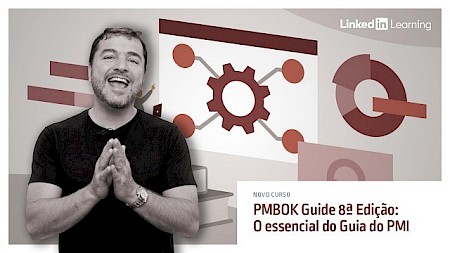
- PMBOK® Guide 8th Edition: The Essentials of the PMI Guide
Focuses on value delivery, adaptive leadership, and modern project management aligned with the latest PMI thinking.
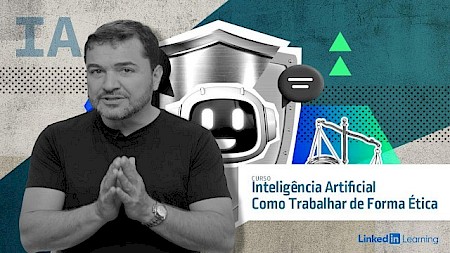
- Artificial Intelligence: How to Work Ethically with AI
Explores how to apply AI responsibly, with a strong focus on ethics, governance, and practical use in daily work.

- How to Become a Leader in Your Industry
A guide to building influence, consistency, and credibility to grow as a recognized leader in your field.
- Project Management in Agribusiness
Covers the realities of managing projects in agriculture, including seasonality, climate risks, and complex supply chains.
- Project Management for Small and Micro Businesses
Focuses on simplicity, speed, and practical execution for smaller organizations.
- First Steps: AI for Small and Micro Businesses
A practical introduction to implementing AI in small businesses in a simple and actionable way.

- Leadership Fundamentals for New Managers
Helps new managers navigate the transition from individual contributor to team leader with confidence.

- How to Become an Effective Project Leader
Focuses on communication, motivation, feedback, and the evolution from managing tasks to leading people.
Although these new courses were recorded in Portuguese, all of them include subtitles in multiple languages, making them accessible to a much broader audience.
My goal has always been simple: to help professionals connect strategy, leadership, technology, and execution in a practical way.
If you haven't explored them yet, you can find the complete collection on my website.
Registration Is Now Open for AI-Driven Project Management Masterclass
I'm pleased to share that registration is now open for the 13th edition of the AI-Driven Project Management Masterclass, which I co-deliver with Antonio Nieto-Rodriguez.
Over the past editions, we've had the privilege of working with hundreds of project professionals from more than 60 countries, exploring how artificial intelligence is transforming the way projects are planned, governed, and delivered.
There's another piece of good news. If you can't join us live, the recording of the latest masterclass is now available, including the complete sessions, slide deck, case studies, prompts, and supporting materials.
Whether you prefer the live interactive experience or the flexibility of learning at your own pace, the goal remains the same: to help project professionals move beyond the hype and develop practical, actionable skills for leading AI-driven projects.
The AIPM Certification Has Just Been Updated
Artificial intelligence is evolving so quickly that any course or certification on the topic risks becoming outdated within months.
That is why I'm pleased to share that the AI-Driven Project Manager (AIPM) Certification has just been updated with new preparation material, an updated exam, and the latest edition of our AI-Driven Project Management Masterclass.
We designed the certification with a simple objective in mind: to help project professionals understand not just the AI tools available today, but how AI is fundamentally changing the way projects are planned, delivered, and governed.
The updated preparation material reflects the rapid evolution we've seen over the past year, incorporating the latest developments in AI-driven project management and ensuring the certification remains relevant in a fast-moving field.
Whether you're looking to build practical AI skills, prepare for the official AIPM exam, or simply stay ahead of where the profession is heading, the updated certification provides a structured path to do exactly that.