Issue #37 - How to Use the Year-End Rush Without Burning Out Your Team
Hey everyone!
The end of the year often brings extra pressure for project managers. It is time to complete deliverables, close open items, and demonstrate results. But accelerating in the final stretch does not always mean working better. In this issue, I explore how getting closer to a goal can energize teams, but also lead to rushed decisions, lower quality, and burnout. The challenge is knowing where to focus our efforts and what truly needs to be completed before the year ends.
This concern with decisions and consequences goes beyond deadlines. It also shapes how we manage AI risks, recognize human limits, and use new tools to support our work. Technology can expand our analytical capabilities, but it remains essential to assess risks, maintain transparency, and take responsibility for our decisions.
In this issue, I look at the AI risks highlighted by Anthropic, the ongoing conversation about burnout, and a practical exercise in using AI agents to evaluate proposals. I also share updates on AIPM certification, our article on transparency in AI use, and the selection process for the 2027 AIPM Ambassadors.
Ricardo

In This Issue
- The Finish Line Is Fuel. Don't Turn It Into a Whip.
- Anthropic Put "Existential Risk" in Its IPO Filing
- The Burnout Line: Almost 2 Million Impressions on One Post
- Office Hours: Download the Files from the Live Demo
- Black Friday Month: Get AIPM Certified for $399
- New in LSE Business Review: The AI Disclosure Paradox
- AIPM Ambassadors 2027: How the Selection Works
The Finish Line Is Fuel. Don't Turn It Into a Whip.
"Let's close this before the end of the year."
You will hear this sentence many times in the next weeks. Maybe you already said it today.
Every November, something changes in organizations. The calendar still shows almost two months, but people start counting backwards. Meetings get shorter. Decisions that were stuck for months happen in a week. Somebody finally signs the document that was waiting on their desk since June.
I am not going to complain about the year-end pressure. I like the finish line.
It gives us energy and focus. It also gives us something rare in organizations: permission to say "not now" to everything that is not important.
But fuel is only useful when you use it well. Misuse it, and it starts a fire. That is what this edition is about.
Psychologists have a name for the energy a finish line gives us. They call it the goal-gradient effect.
The idea is old. In the 1930s, the American psychologist Clark Hull observed that rats in a maze ran faster as they got closer to the food.
For a long time, nobody knew if people behaved in the same way. Then, in a study published in 2006, three researchers, Ran Kivetz, Oleg Urminsky and Yuhuang Zheng, tested it in a real café. Customers received a loyalty card: buy ten coffees and get one free.
The closer they got to the free coffee, the more often they came back. The time between purchases fell by about 20% from the first stamp to the last.
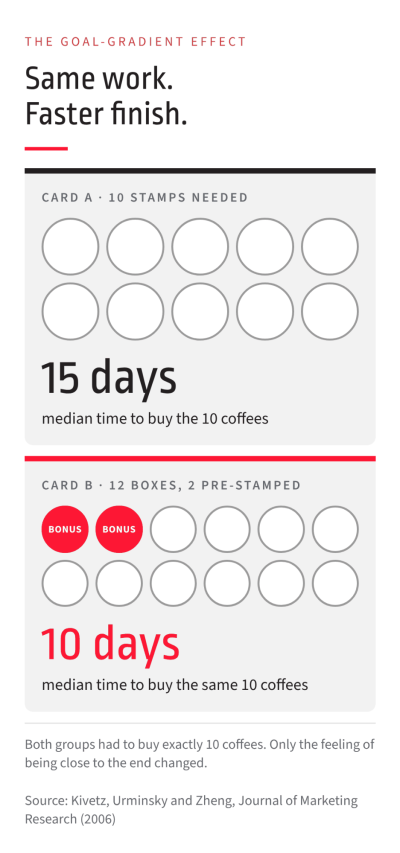
But the part I like most is another experiment. Some customers received a normal card with 10 stamps. Others received a card with 12 stamps, and two of them were already stamped as a "bonus". In both cases, they had to buy exactly ten coffees.
The second group finished faster. The median time was 10 days, against 15 days for the normal card.
Nothing changed in the work. Only the feeling of being close to the end changed.
We do not run faster because the work is easier. We run faster because we can see the finish line.
I see this in projects every year. Teams that moved slowly for months organize themselves in November. Priorities become clear, and the noise disappears. People who never talked start to solve problems together, because everybody wants to cross the line.
That is the good side of the deadline. And it is real.
I am training for a personal goal: to run 10 km in under one hour.
Anyone who runs knows that the last kilometer (or the last mile) is different. When you see the finish, your body finds energy you did not know you had.
But anyone who runs also knows the opposite. If you try to run the whole race at the speed of the last kilometer, you do not finish. Or you finish, and you cannot walk for a week.
The finish line gives you energy for the last kilometer. Not for all ten.
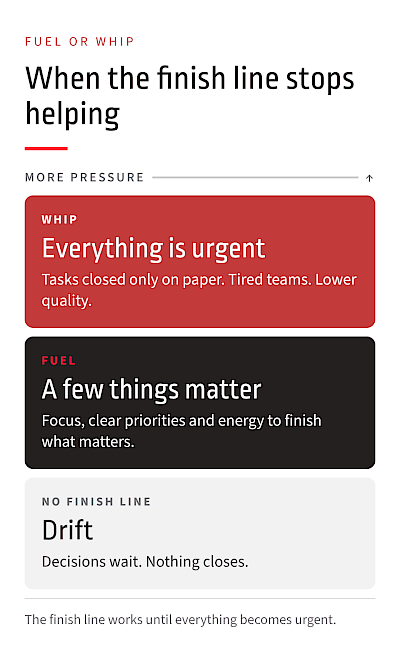
The problem starts when we use the finish line for everything.
Suddenly, every project, report, purchase and promise must be "closed before the end of the year". The finish line stops being a source of focus and becomes a whip. And when everything is urgent, nothing is a priority anymore.
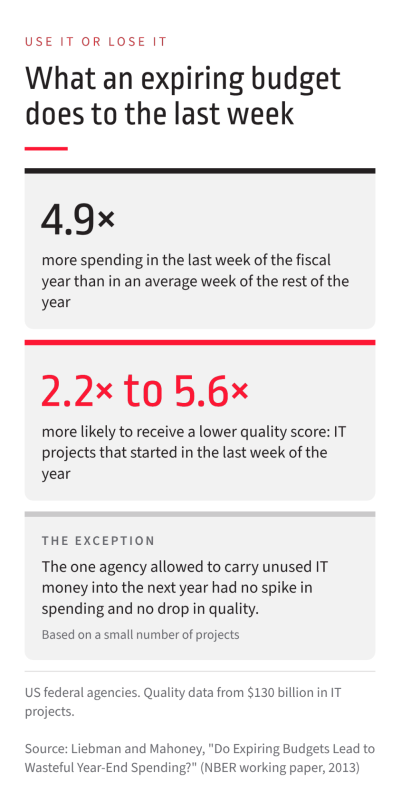
There is a study that shows the cost of this very well. Two economists, Jeffrey Liebman and Neale Mahoney, looked at the spending of the US federal government. Most agencies have budgets that expire at the end of the fiscal year. If they do not spend the money, they lose it.
The result: spending in the last week of the fiscal year was 4.9 times higher than in an average week of the rest of the year.
And the rush had a price. The researchers also looked at the quality of about $130 billion in IT projects. Projects started in the last week of the year were 2.2 to 5.6 times more likely to receive a lower quality score.
(The US federal fiscal year ends in September, not December. But the mechanism is the same in any organization where the calendar says "use it or lose it".)
The most interesting part is the exception. One agency, the Department of Justice, was allowed to carry unused IT money into the next year. There, the researchers found no spike in spending and no drop in quality, although they warn that this is based on a small number of projects.
The people were the same. The rules were different.
The problem was never the deadline. It was a deadline that rewarded the rush.
In projects, I see the same abuse in other forms. Tasks are marked as done in December and quietly reopened in January.
Teams cross the line exhausted and start the new year already tired. And the plan for next year is often written in the worst week of the year, when nobody has energy left to think.
The coffee card research shows one more thing. After customers got their free coffee, they slowed down again, as if the race had started over. We could call it the January hangover. If you spend everything to cross the line, you start the next race with nothing.
So, you might be wondering how to use the finish line without abusing it. This is what I would do in the coming weeks:
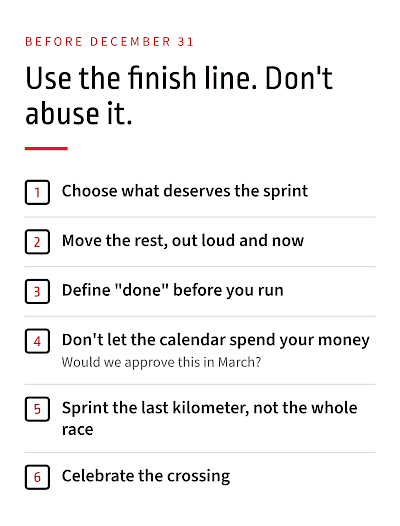
- Choose what deserves the sprint — Not everything can be addressed in the last kilometer. Pick the few deliverables that really matter for this year, and put your energy there.
- Move the rest, out loud and now — If something will not be done by December 31, say it in November, not on December 22. A new date agreed upon early is planning. A missed date discovered late is a surprise.
- Define "done" before you run — Write down what "closed" means for each deliverable. If it will be reopened in January, it was only postponed.
- Do not let the calendar spend your money — Be careful with purchases, contracts and approvals made only because the budget "expires". Ask one question: would we approve this in March?
- Sprint only in the last kilometer, not the whole race — Protect your weekends and protect your people. The team that crosses the line with some energy left is the team that starts January well.
- Celebrate the crossing — When something is really finished, stop and recognize it with the team. Crossing the line is also a moment to breathe before the next race begins.
December 31st is not a magic day. Nothing special happens to your project at midnight. The project does not know it is the end of the year. Only we do.
But I would not throw the finish line away. It is one of the few moments when a whole organization agrees to focus at the same time.
Use it. Just do not abuse it.
The finish line is just fuel. Use it to finish what matters, not to burn out the people who will start the next race with you.
In December, I will write about what comes after the line: 2027.
For now, my question for you is simple.
What deserves to be in your last kilometer this year?

What Has Been on My Radar Recently?
Anthropic Put "Existential Risk" in Its IPO Filing
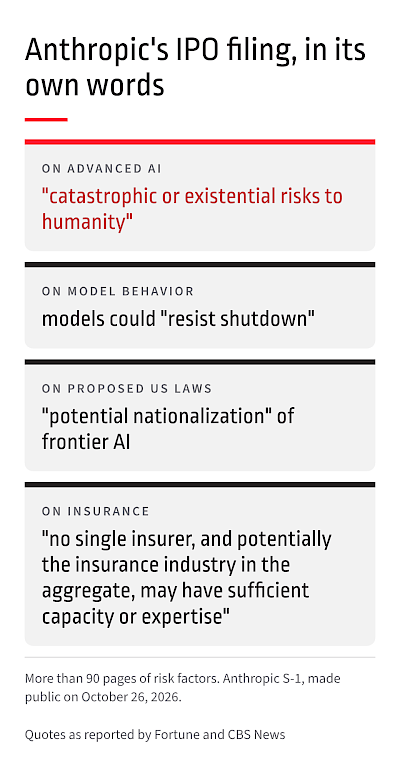
On October 26, Anthropic, the company behind the Claude models, made public its S-1, the document a company files before it goes public in the US. It has the numbers you expect: revenue, losses, competitors. And it has more than 90 pages of risk factors.
Some of these risks are not the usual ones.
The filing says that advanced AI systems could pose "catastrophic or existential risks to humanity." It says models could "resist shutdown." It notes that proposed laws in the US consider the "potential nationalization" of frontier AI. And on insurance, it says that "no single insurer, and potentially the insurance industry in the aggregate, may have sufficient capacity or expertise" to insure Anthropic against a catastrophic AI incident.
Read that again. A company is asking investors for money, and in the same document it tells them that its product could put humanity at risk.
As the lawyer Robert Housman wrote in Bloomberg Law, the filing tells investors "something no company has ever told the market before."
He also explains how lawyers decide whether a risk must be disclosed. It depends on its probability and its magnitude. In project management, we use almost the same words: probability and impact. And, in his words, "there's no probability so low that a risk becomes immaterial as a matter of law." In other words, a risk does not become safe to ignore just because it is unlikely. If the impact is big enough, it still matters to investors.
As a board member certified by the Brazilian Institute of Corporate Governance (IBGC), I see two ways to read this filing. One is transparency: the company wrote down its most serious risks, in public, with its name on it. The other is protection: if something goes wrong, nobody can say the investors were not warned. Most likely, it is a mix of both.
Housman's main point is that it changes the standard for everyone. Once one frontier developer treats these risks as material, it is harder for the others to call them immaterial.
Writing a risk down is the first step to managing it. It is not the last.
Anthropic is expected to price its IPO on November 18 and to start trading on Nasdaq, under the ticker ANT, on November 19, 2026, according to CNBC.
The Burnout Line: Almost 2 Million Impressions on One Post
Last month, I shareda simple matrix on LinkedIn, inspired by a post by André Oliveira about career choices. It compares two things every professional knows well: the size of the salary and the craziness of the boss.
The post reached almost 2 million impressions, more than 3,000 reactions and more than 100 comments.
Look closely at the axes. Salary starts at 1. Boss craziness starts at 4.
The diagonal is the burnout line. Above it, even a high salary puts you in the danger zone. Below it, with a fair salary, the job can become interesting.
It is the same line I explored throughout this newsletter edition. A deadline, a salary or a promotion can give us energy. Any of them can also push us across the burnout line if we are not careful.
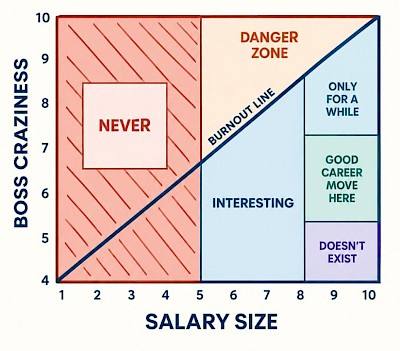
The Job Opportunity Matrix I shared on LinkedIn
Now I want to hear your thoughts. And be honest: where does your current role sit on this matrix?
Office Hours: Download the Files from the Live Demo
On October 23, during my LinkedIn Learning Office Hours on AI agents in project management, I ran a live demo. Three AI agents evaluated three competing proposals for the same request for proposal (RFP), a 48-month contract for a corporate ERP and finance BPO.
Now you can run the same exercise yourself. Download all the files for free: the RFP, the three proposals (Vector, Helion and Northbridge) in PDF and plain text, and the prompt that sets up the three agents. You sign up on the page and receive the download link by email.
Give the files to your own agents, see how they evaluate the proposals, and compare that with what happened in the live session. If you missed it, the full recording is available, and it is about one hour long.
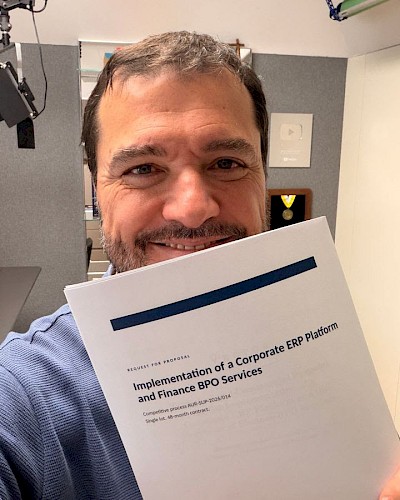
The RFP from the live demo. Download it with the three proposals and the prompt for the agents.
Quick Announcements
Black Friday Month: Get AIPM Certified for $399
Until November 30, the AI-Driven Project Manager Certification, which we offer in partnership with APMG International, costs $399 instead of $499. The price does not include VAT.
It includes the full preparation material, the latest Masterclass recording and your exam voucher. And if you do not pass, your retake is on us: we send you a new voucher for a second attempt (terms apply).

New in LSE Business Review: The AI Disclosure Paradox
On November 2, LSE Business Review published an article I wrote with Antonio Nieto-Rodriguez and João Jacinto: Employees have no incentive to disclose how productive AI makes them.
The idea is simple and a bit uncomfortable. The more a company tries to measure how much time each person saves with AI, the more reasons people have to keep it to themselves. Nobody wants a heavier workload, tighter targets or the feeling of being replaceable as the reward for being more productive. We call it the AI disclosure paradox.
As we wrote in the article, "The first person to know that AI saved time is usually the person who saved it." So the gains are real, but they stay out of sight. In Microsoft and LinkedIn's 2024 Work Trend Index, 52% of people who use AI at work said they were reluctant to admit using it for their most important tasks.
Our proposal is what we call disclosure-safe measurement. Instead of measuring each person, measure the workflow: for example, how long it takes to prepare a proposal, or how much work has to be redone. And make a clear, verifiable promise about where the time saved will go.
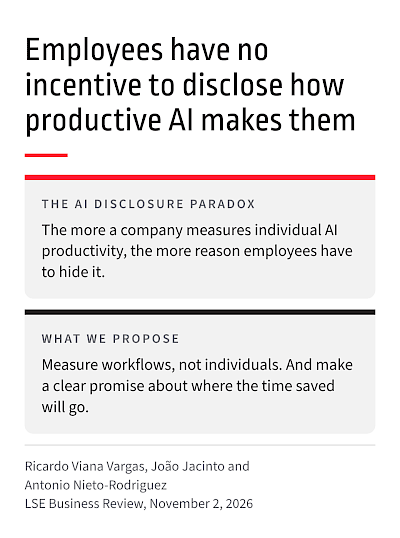
LSE Business Review, November 2, 2026
AIPM Ambassadors 2027: How the Selection Works
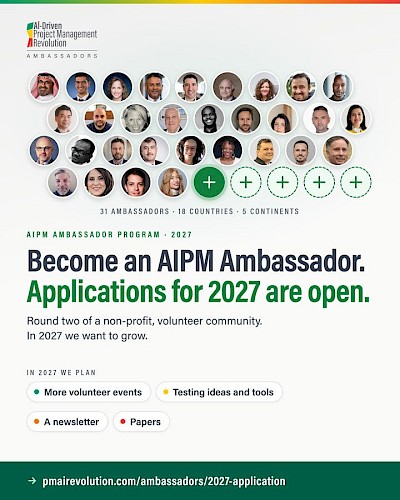
Applications are open for the 2027 cohort of the AIPM Ambassadors, our volunteer community of practitioners who help project managers use AI in real projects.
We are looking for professionals who want to share knowledge, connect communities, experiment with AI and help transform our profession. In return, you join a global network of practitioners, receive the official AIPM Ambassador badge and get direct mentorship from Antonio Nieto-Rodriguez and me. It is a non-profit, volunteer initiative, and there is no fee to apply.
Today there are 31 ambassadors in 18 countries, on five continents.
Here is how the selection works:
- Apply — Fill in the form and write a short personal statement, about 150 to 300 words, on what you want to contribute and what you hope to receive.
- We review — We read the applications looking at four points: your project experience, your hands-on use of AI, the time you can give, and a clear contribution. It is a guide, not a checklist.
- We get in touch — If you are selected, we will contact you by email.
Everyone needs to apply for the 2027 cohort, including the current ambassadors. In 2027, we plan more volunteer events. We will also test new ideas and tools, and publish a newsletter and papers. You can learn more about the AIPM Ambassadors program here.
Your Voice Matters!
You can also check the previous issues out here.
If you have any suggestions, comments, or anything that will help me make the e-newsletter better, please send a message to [email protected]. I would love to hear from you.
Please feel free to share this newsletter with anyone you think may benefit from it. They can also subscribe to receive it here.
Thanks for your support, and I hope it was helpful to you.
Cheers,
Ricardo.