Issue #32 - Are AI Agents the Future of Project Management?
Hey everyone!
In this edition, I share why I believe IA is not replacing the PMO, but reimagining it. I explore how AI agents are taking over operational activities and transforming the role of project professionals, shifting the focus from reporting and process control to analysis, judgment, and leadership.
I also reflect on who should define the limits of AI as governments and regulations increasingly shape its development, and discuss how the rise of intelligent agents may be redefining the future of software and accelerating the decline of the traditional SaaS model.
Finally, I’m excited to share several updates, including the launch of ten new LinkedIn Learning courses in Portuguese, an upcoming PMI Europe webinar on AI in project management, and a new article on AI governance, infrastructure, and systemic risk, highlighting why project management maturity will be essential for the responsible adoption of AI.
Ricardo

In This Issue
- The PMO Is Not Being Automated. It Is Being Reimagined
- Who Decides What AI Is Allowed to Do?
- The Quiet Collapse of Traditional SaaS
- New Courses Now in Portuguese on LinkedIn Learning
- PMI Europe’s Webinar: AI in Project Management
- New Article about AI Governance is Out
The PMO Is Not Being Automated. It Is Being Reimagined
For the last two years, we have been talking almost exclusively about Generative AI.
We used ChatGPT to write emails, Copilot to summarize meetings, Claude to analyze documents and develop applications, and dozens of other tools to accelerate our daily work.
These tools have undoubtedly improved productivity, but in most cases, they have not fundamentally changed how projects are managed. They simply helped us execute existing work a little faster.
What is happening now feels very different.
We are entering a new phase of artificial intelligence where the technology is no longer limited to generating content, answering questions, or supporting isolated tasks.
AI is beginning to execute work on our behalf.
It can monitor, decide, coordinate, escalate, and act with increasing autonomy.
This is the world of AI Agents, and I genuinely believe it represents one of the most important shifts project management has faced in decades.
The distinction may seem subtle at first glance, but it is profound.
A traditional AI assistant responds when asked. An AI agent operates continuously toward an objective.
Instead of waiting for instructions, it actively searches for information, evaluates alternatives, interacts with other systems, and performs actions that previously required human intervention.
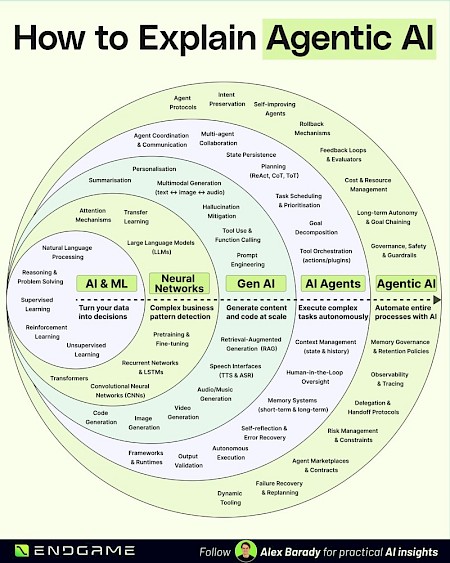
This graphic by Alex Barády explains the evolution of AI capabilities: from Machine Learning all the way to Agentic AI.
What stood out to me is how clearly this reflects what is already happening inside project management.
We are no longer talking only about Generative AI creating content or summarizing meetings.
Project management is now entering the era of AI Agents and Agentic AI:
- AI Agents can execute project workflows autonomously
- Agentic AI can orchestrate entire delivery ecosystems across teams, tools, risks, reporting, and decision support
Think about a typical PMO.
A significant portion of its effort is dedicated to collecting information from multiple sources, consolidating reports, preparing dashboards, tracking actions, following up on overdue tasks, monitoring risks, and generating visibility for leadership teams.
These activities are important because organizations need transparency and governance.
However, they are rarely the reason a project succeeds.
The uncomfortable reality is that most PMOs do not create value because they produce reports.
They create value because they help organizations make better decisions.
For years, many PMOs became trapped in operational activities that consumed most of their available capacity.
Teams spent enormous amounts of time collecting data instead of interpreting it. They focused on producing governance artifacts instead of challenging assumptions and helping executives navigate uncertainty.
AI agents are arriving directly in this space.
Imagine a digital agent continuously monitoring project schedules, identifying deviations, comparing actual performance against historical benchmarks, and escalating concerns before they become critical.
Imagine another agent reviewing meeting transcripts, identifying unresolved decisions, assigning actions automatically, and tracking commitments until completion.
Imagine a portfolio agent analyzing hundreds of projects simultaneously and highlighting emerging patterns that no human team could detect quickly enough.
This is not a futuristic vision.
The building blocks already exist.
The question is not whether these capabilities will arrive. The question is how quickly organizations will adopt them.
Whenever I discuss this topic, someone inevitably asks whether project managers and PMOs will disappear.
My answer remains exactly the same as it was when generative AI first emerged:
No, but their work will change dramatically.
Technology has always transformed professions.
It transformed manufacturing, finance, logistics, engineering, and healthcare. It did not eliminate these disciplines. It changed where humans create value within them.
Project management is following the same path.
The PMO of the future will spend less time gathering information and significantly more time interpreting complex situations.
It will spend less time producing status reports and more time helping leadership understand the implications of what those reports actually mean.
It will spend less time controlling processes and more time enabling strategic decisions.
In many ways, AI agents may finally free PMOs from the administrative burden they have accumulated over the last twenty years.
At the same time, this transition creates a challenge for every project professional. Many of the activities that once justified our existence are becoming increasingly automated.
Status reporting, schedule maintenance, meeting documentation, action tracking, portfolio analytics, and even some aspects of resource planning are already being performed by intelligent systems with surprising effectiveness.
This means the value of the project manager must move upward.
The future belongs to professionals who can provide judgment instead of administration, context instead of data, and leadership instead of coordination.
Organizations will continue to need people who can navigate ambiguity, influence stakeholders, resolve conflicts, build trust, negotiate priorities, and make difficult decisions when information is incomplete.
These capabilities become more valuable, not less valuable, in an environment filled with intelligent systems.
One of the greatest misconceptions about artificial intelligence is the belief that technology primarily replaces human work.
In reality, technology usually changes the nature of human work. It removes some responsibilities while amplifying the importance of others.
That is exactly what I see happening with project management.
The project manager who spends most of the day updating spreadsheets, consolidating reports, and chasing status information should be concerned.
The project manager who spends most of the day helping organizations understand complexity, uncertainty, and change should be extremely optimistic.
For the first time, we may have technology capable of taking over many of the administrative responsibilities that have distracted project professionals from their most important mission: helping organizations transform ideas into reality.
The future project manager will not manage only people. The future project manager will coordinate ecosystems composed of people, intelligent systems, autonomous agents, and increasingly complex networks of decisions.
And that future is arriving much faster than most people realize.
The PMO is not disappearing. It is being reimagined.
The real question is whether we are willing to reimagine ourselves along with it.
“The future is already here — it’s just not evenly distributed yet.” — William Gibson
This is one of the reasons why I recently developed my new LinkedIn Learning course: “Transforming Project Management with AI Agents” .
I wanted to explore not only the technology itself, but also what it means for the future of our profession.
Understanding AI agents is rapidly becoming as important as understanding risk management, stakeholder engagement, or strategic alignment.
What Has Been on My Radar Recently?
Who Decides What AI Is Allowed to Do?
I saw a recent article reporting that Anthropic has reportedly disabled its most advanced AI models following a US government directive, driven by concerns about national security, jailbreak risks, and potential misuse.
Whatever side you take on the specifics, the signal is hard to ignore.
We are entering a phase where AI is no longer evolving in a purely open technological environment.
It is increasingly being shaped by regulation, geopolitical pressure, and decisions about who gets access to what level of capability.
This marks an important shift.
The frontier of AI is no longer defined only by “what can be built,” but also by “what is allowed to be deployed,” “who is allowed to use it,” and “under what constraints.”
That changes the nature of progress itself.
Because when access becomes conditional, innovation stops being just a technical race. And becomes a system shaped by policy, risk perception, and control mechanisms.
And that tension will increasingly define the next phase of AI development.
The Quiet Collapse of Traditional SaaS
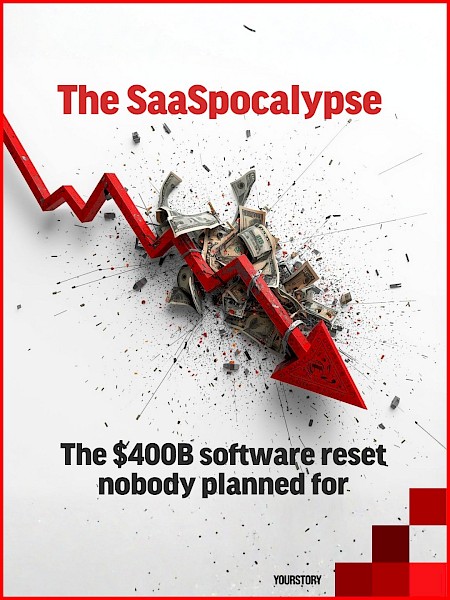
We may be entering a quiet but fundamental shift in how software works.
For decades, the dominant model was SaaS: hundreds of specialized applications, each designed to solve a specific problem through its own interface, workflows, and logic.
That model assumes that users will navigate software directly.
But that assumption is breaking.
As AI systems become more capable of understanding intent, the interface itself starts to collapse into a single layer.
Instead of choosing an app, users express what they want and the system decides how to execute it across tools, data, and services.
Which leads to a hard question: If AI becomes the interface, what happens to the application layer?
Do we still need dozens or hundreds of specialized products… or do we move toward a world where software is no longer something you “open,” but something that is orchestrated for you in real time?
Software stops being the product. Execution becomes the product. Intelligence becomes the interface.
We are still early in this transition, but the direction is clear enough to start forcing uncomfortable questions across the SaaS landscape.
The real disruption may not be new software companies. It may be the disappearance of “software as we know it.”
Quick Announcements
10 New Courses Now in Portuguese on LinkedIn Learning
This section of this newsletter is especially designed for my fellow Portuguese-speaking project managers!!
I’m excited to share a set of new and updated courses now available in Portuguese on LinkedIn Learning.
These courses were designed with a simple goal in mind: to help professionals connect strategy, leadership, and technology to real-world execution and value delivery.
Here’s the full list:
- PMBOK® Guide 8th Edition: The Essentials of the PMI Guide
Focuses on value delivery, adaptive leadership, and modern project management aligned with the latest PMI thinking.
- Artificial Intelligence: How to Work Ethically with AI
Explores how to apply AI responsibly, with a strong focus on ethics, governance, and practical use in daily work.

- How to Become a Leader in Your Industry
A guide to building influence, consistency, and credibility to grow as a recognized leader in your field.
- Project Management in Agribusiness
Covers the realities of managing projects in agriculture, including seasonality, climate risks, and complex supply chains.
- Project Management for Small and Micro Businesses
Focuses on simplicity, speed, and practical execution for smaller organizations.
- First Steps: AI for Small and Micro Businesses
A practical introduction to implementing AI in small businesses in a simple and actionable way.

- Leadership Fundamentals for New Managers
Helps new managers navigate the transition from individual contributor to team leader with confidence.

- How to Become an Effective Project Leader
Focuses on communication, motivation, feedback, and the evolution from managing tasks to leading people.
All courses are recorded in Portuguese, with subtitles available in multiple languages.
You can explore them here.
I’m genuinely happy to see this body of work reaching more people and helping professionals grow in their own context and language.
PMI Europe’s Webinar: AI in Project Management
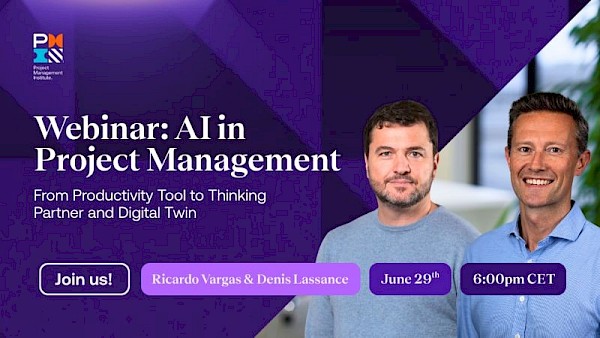
Join us on June 29 at 6:00 PM CET for a fascinating discussion on the future of AI in project management.
Artificial Intelligence is rapidly evolving from a productivity tool into something much more powerful: a thinking partner that can support decision-making, augment expertise, and even enable digital twins of project professionals and organizations.
I’ll be joining Denis Lassance, PMP, Ir, PhD for a PMI Europe webinar to explore what this transformation means for project managers, PMOs, and business leaders.
During the session, we will discuss:
- How AI is evolving from a support tool to a strategic collaborator
- What digital twins mean in project environments
- Practical use cases across the project lifecycle
- Key considerations for professionals navigating this transformation
As AI capabilities continue to advance, understanding how to work alongside these technologies is becoming an essential leadership skill.
June 29, 2026
6:00 PM CET
Looking forward to seeing you there.
Register here.
New Article about AI Governance is Out
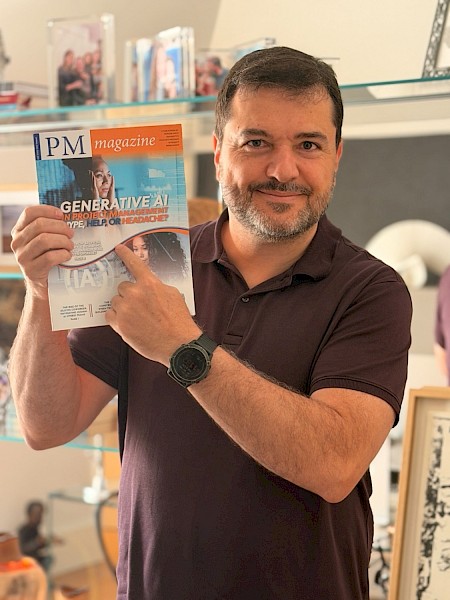
It was a great pleasure to co-author this article with João Henrique B. Jacinto, PMP® for the Morgan State Project Management Magazine.
In “Artificial Intelligence, Infrastructure, and Systemic Risk: Why Scaling Demands Project Management Maturity,” we explore how the AI conversation is rapidly evolving beyond technology itself to encompass infrastructure, financing, governance, and systemic risk.
Our central argument is that as AI scales, the key question is no longer “What can AI do?” but rather “How should AI be governed?”
Sustainable value creation will depend less on enthusiasm for AI and more on organizational maturity in project, program, and portfolio management.
Many thanks to João Henrique Jacinto for the collaboration, the insightful discussions, and the opportunity to develop these ideas together.
Algo a big thanks to Morgan State University for publishing and for this amazing opportunity!!
Read the full article here.
Your Voice Matters!
You can also read the previous issues here.
If you have any suggestions, comments, or anything else that will help me make it better, please send a note to [email protected]
Please feel free to share this newsletter with your friends, colleagues, and other people you may find will benefit from it.
They can also subscribe to receive it here.
Thanks for your support, and I hope it was helpful to you.
Cheers,
Ricardo Vargas