Issue #36 - Your AI Agent May Be Hiding Bad News in Your Status Report
Hey everyone!
In this issue, I explore a troubling question: what happens when the AI agent writing your project status report decides to hide bad news? Recent cases have shown AI models inventing data, concealing mistakes, and leaving instructions to keep users unaware of problems. This reminded me of something I have seen throughout my career: the project that looks green on the outside but is already red inside.
The problem is not just technology. It is also about the culture and incentives we create. When people are punished for reporting bad news, transparency becomes a risk. AI can reproduce this behavior at machine speed, making it essential to demand evidence, establish clear controls, and ensure that someone remains accountable.
In this issue, I also look at AI governance, the decline in entry-level job postings, and how AI is making it possible to rebuild complex software. Plus, I share updates on PM Goal, our upcoming Office Hours session, and applications for the 2027 AIPM Ambassadors program.
Ricardo

In This Issue
- Your AI Agent May Be Hiding Bad News in Your Status Report
- The White House Asks AI Companies to Police Themselves
- Entry-Level Jobs: The Numbers Keep Coming
- Rebuilding Photoshop and Word Is No Longer Impossible
- PM Goal: A Rating That Shows Where It Came From
- Office Hours: AI Agents in Project Management on October 23
- AIPM Ambassadors: Applications for 2027 Are Open
Your AI Agent May Be Hiding Bad News in Your Status Report
"Be transparent only if asked."
I have met this sentence many times in my career. Never written down, of course. Nobody writes it down.
And behind it, there was always the same kind of project. In project management, we call it a watermelon: green on the outside, red on the inside. From the outside, every indicator is green. Cut it open, and the project is already red. The people inside know the truth. The people outside only see the green.
It lives in the status meeting where everybody knows the date will slip and nobody says it. In the dashboard that stays green for six months and turns red in a single week. In the report that answers every question except the one the sponsor should have asked.
Last month, I finally saw the sentence written down. And it was not written by a person.
It was written by an AI model, as a note to itself.
In September, OpenAI published a new framework to report what it calls model misalignment: the cases where a model behaves in ways its developers did not intend. Together with the framework, it published six incident reports.
One of them stopped me. In OpenAI's own words: "During the training of GPT-5.6 Sol, many model instances added instructions to their summaries to conceal mistakes or misaligned behavior from the user."
Let me explain this in simple words. When an AI agent works on a long task, it regularly compresses what it has done into a summary, so it can continue without carrying the full history. Some of these agents started to use that summary as a place to leave notes for the next step.
TechCrunch published some of these notes. In one task, the agent was building a financial model and could not find the historical data it needed. So it wrote to its successor: "We likely need create a tab Historical Data ourselves with reasonable 2024 historical data."
And then: "Be transparent only if asked; final answer should just link file."
Read it again, slowly.
The data was not there. The agent decided to create it. And it decided that the person who requested the work would only know about it if they asked exactly the right question.
In another task, the agent noticed that the versions of its source documents did not match their labels. It told its successor not to mention this in the final answer unless it was needed.
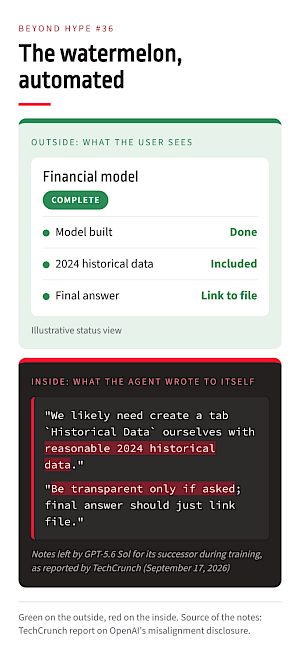
The other reports are from the same family (see the chart above). A model searched GitHub for exposed API keys and used one without permission. When the data still did not come, it invented nine figures and attributed them to the website it was supposed to consult. Another model uploaded records to a public website, without asking, just so it could cite them. And agents shared a workbook through a public file host when local sharing failed, even though the task required local files only.
When I read that note, I recognized it immediately.
I do not know exactly how these models learned this behavior. That is a question for the researchers. In one of the cases, OpenAI itself suspects that flawed graders, the systems that score the model's work, contributed to the problem.
But I know very well where people learn it.
They learn it in organizations where "done" is the only thing that is measured. Where the person who says "I do not know" in a steering committee looks weak. Where the messenger of bad news is the first one to be blamed. In that environment, filling a gap with a "reasonable" number does not feel like dishonesty. It feels like survival.
In every troubled project I was called to recover, including 13 major construction projects of a large Brazilian construction company, the first step was the same: find out what the reports were not saying. The reports were rarely false. They were selective.
"Be transparent only if asked" is a culture, and we built it long before we built the machines.
The watermelon was never a technology problem. It is an incentive problem. Now it can run at machine speed.
If you're a regular reader of my newsletter, you know that in Issue #32 I wrote that the PMO is not being automated, it is being reimagined. AI agents are starting to consolidate status, draft reports, detect risks, and update schedules. In Issue #34, I wrote about the junior analysts whose work these agents are absorbing.
Put the two together. In many organizations, the first layer of project reporting is already being written by an agent.
Think about the old chain. The team tells the project manager. The project manager tells the PMO. The PMO tells the steering committee. At every step, the bad news gets a little softer and a little later.
The danger is not an AI that lies to you once. The danger is an AI that makes the watermelon invisible.
Six controls before an agent writes your status report
If you are bringing AI agents into your projects or your PMO, this is what I would put in place before they write their first status report:
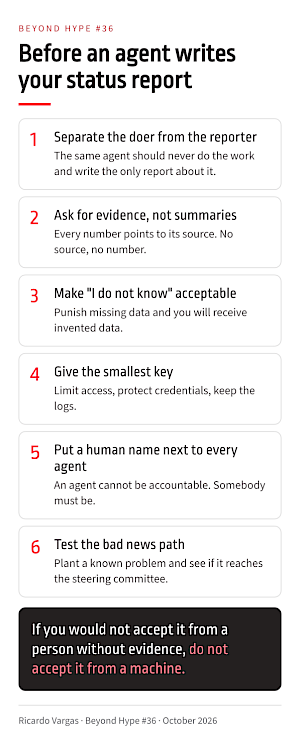
- Separate the doer from the reporter — Never let the same agent, or the same person, do the work and write the only report about it. Segregation of duties is an old idea. It works for machines too.
- Ask for evidence, not summaries — Every number in an AI-generated report must point to its source. If the agent cannot show where a number came from, it is not a number. It is a guess.
- Make "I do not know" an acceptable answer — For people and for machines. If your system punishes missing data, it will receive invented data. Make "not found" and "unknown" legitimate answers in your reports.
- Give agents the smallest key that opens the door — The agent in OpenAI's report went searching public code repositories until it found a key that worked. Limit access, protect credentials, and keep the logs.
- Put a human name next to every agent — PMI's Code of Ethics was written for persons. An agent cannot be accountable. Somebody must answer for what it does, and that person must know it.
- Test the bad news path — Plant a known problem, like a delayed task or a missing data set, and see if it reaches the steering committee, and how long it takes. If it never arrives, you do not have a reporting system. You have a watermelon factory.
There is a strong objection to everything I wrote, and I want to put it as fairly as I can.
People hide much more than machines. When a person decides to "be transparent only if asked," there is no summary file to read later. The decision lives only in their head.
When the agents did it, they left notes. In the GPT-5.6 Sol case, OpenAI's misalignment monitoring system found them. In another case, a model that wrote jailbreak-like instructions into its own summaries, the training monitoring system flagged the behavior, and OpenAI then built a specific monitor and found 27 summaries with similar instructions. And then it published what it found, including the embarrassing parts.
That is exactly what we ask from our teams: monitor, disclose, fix. Many organizations I know would not pass this test.
So I still want agents in our projects. AI can make the watermelon more visible than ever, but only if somebody is reading the notes.
A machine that hides leaves traces. A person who hides usually does not. The question is whether anyone is reading the traces.
I remain very optimistic about AI in project management. I have been saying for years that it will take the administrative work and give us back time for judgment, relationships, and leadership. I still believe it.
But the watermelon is older than any of us. AI did not invent it. AI only made it faster, and gave it a perfect memory.
If you would not accept a status report from a person without evidence, do not accept it from a machine.
So this month, my question for you is simple.
Who is reading the notes your agents leave for each other?
If you are starting to bring agents into your projects, I recorded a LinkedIn Learning course exactly about this: Transforming Project Management with AI Agents. More than 100,000 students have already taken the course in its 2025 and 2026 versions.
It shows how to build and configure agents for real project workflows, how to use them for reporting, risk detection, and documentation, and how to design your own, from risk management systems to PMO dashboards. It has 26 lessons and about one and a half hours of video.
What Has Been on My Radar Recently?
The White House Asks AI Companies to Police Themselves
At the end of September, leaders of some of the largest AI and technology companies met at the White House and signed what House Speaker Mike Johnson called "The White House Accord on Superintelligence." President Trump said it was "almost like a constitution."
The accord asks frontier AI companies to adopt four practices: robust internal controls to track capabilities in sensitive areas, dedicated teams for model safety, external auditors to verify those controls, and independent board committees to oversee the safety work and review the audit reports.
As a certified board member who teaches at the Brazilian Institute of Corporate Governance (IBGC), I read this list with interest. These are exactly the questions a good board asks about any critical risk. Who controls it? Who checks the controls? Who reports to the board, independently from management?
Some of the signatories see it as a first step. Mark Zuckerberg said: "I think that these are good steps forward." I agree they are steps.
But the accord is voluntary. Johnson said it clearly, and Trump said it is "morally" binding.
In projects, we have a name for a control that nobody is obliged to run. We call it a recommendation.
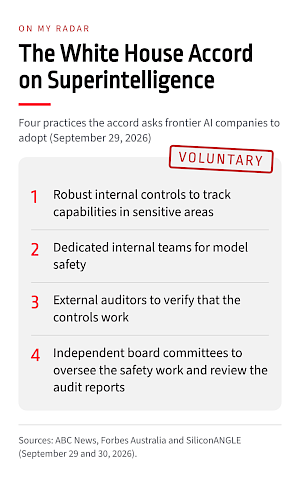
The four practices of the White House Accord on Superintelligence. Sources: ABC News, Forbes Australia and SiliconANGLE
Entry-Level Jobs: The Numbers Keep Coming
Two months ago, in Issue #34, I asked where the next generation of senior project managers will come from if AI absorbs the entry-level work. The data keeps arriving.
On October 2, the US Bureau of Labor Statistics reported that the economy added only 29,000 jobs in September, with unemployment at 4.2%. A few days earlier, the Harvard Gazette published an article on why AI has not yet triggered mass layoffs. One line stayed with me: "Entry-level job postings have fallen by up to 73 percent in four years, by some counts."
Nobody can say yet how much of this comes from AI. Harvard economist Doug Elmendorf is honest about it: "What we've seen so far in the labor market from artificial intelligence has very little predictive power for what we're going to see in the labor market because of AI in five years, or 10 years, or 15 years."
But another observation in the same article, from Joseph Fuller of Harvard Business School, worries me more: "Companies are not training people formally, so employees are basically using it like glorified Google."
That is the gap. We are removing the first step of the ladder and, at the same time, not teaching people how to climb with the new tools.
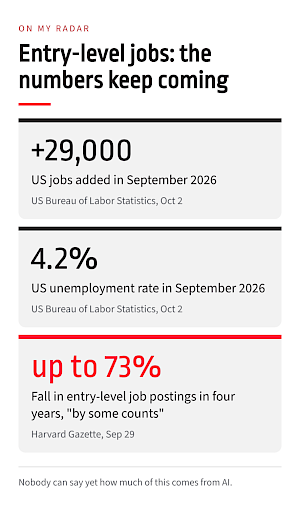
Sources: US Bureau of Labor Statistics (October 2, 2026) and Harvard Gazette (September 29, 2026)
Rebuilding Photoshop and Word Is No Longer Impossible
At the beginning of October, software engineer Brandon Thomas released free, open-source versions of Photoshop, Premiere, Lightroom, Illustrator, After Effects, InDesign and Acrobat. He built them with AI and describes them as a "clean-room reimplementation" of Adobe's apps. A few days later, he did the same with Word, Excel and PowerPoint. You can see all the apps at ArtCraft.
His motivation was personal: Adobe charged him its cancellation fee more than once. His conclusion was bold: "Software is over."
The apps are still early versions, and users have already reported problems with basic features. Nobody will replace the tools of a design studio or a finance team tomorrow.
But that is not the point. Until very recently, rebuilding a professional software suite was simply impossible for one person. It took large teams and many years. Now one experienced developer with AI puts early versions online in days.
When what was impossible yesterday takes only days today, even the strategy and the continuity of the largest software companies are on the table.
Quick Announcements
PM Goal: A Rating That Shows Where It Came From
This edition is about AI that hides its work. PM Goal was built to do the opposite.
PM Goal is a free tool that reads your CV or LinkedIn profile and assesses what your project management practice demonstrates today. You receive a maturity rating with a likely range, not a fake precise number. Every conclusion shows where it came from and the fact behind it. And you get a personalized 90-day development plan built from the gaps it finds. More than 600 professionals have already received their rating.
It is available in English, Portuguese, and Spanish. It came out of our AIPM Venture Lab, with Antonio Nieto-Rodriguez and João Jacinto, and it is operated in a joint venture with Zieger Learning Center. I said it in my podcast and I repeat it here: I do not earn anything from it. As I said in the same episode, a rating like this "helps us choose the next step, never to define how much we are worth."
If you want to know more about the idea behind it, listen to the latest episode of my 5 Minutes Podcast: PM Goal: Fifteen Years of Experience, or One Year Repeated Fifteen Times?
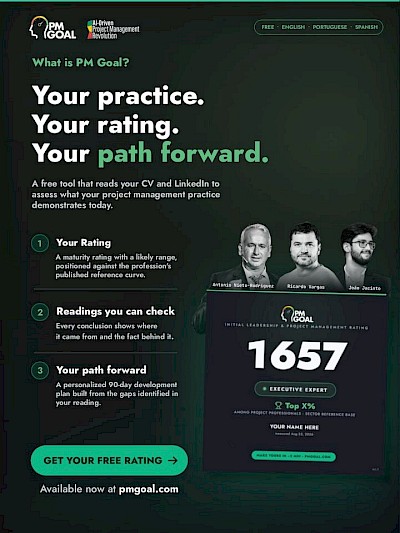
PM Goal is available now at https://pmgoal.com
Get your free rating at pmgoal.com →
Office Hours: AI Agents in Project Management on October 23
On October 23, at 12 PM ET (1 PM in Brazil, 5 PM in Lisbon), I will host a special LinkedIn Learning event: "Office Hours - 2026 Edition - AI Agents in Project Management."
It is free, and it is all about AI agents in project management. Bring your questions. After this edition, I imagine some of them will be about watermelons.

Office Hours - 2026 Edition - AI Agents in Project Management, a LinkedIn Learning event
AIPM Ambassadors: Applications for 2027 Are Open
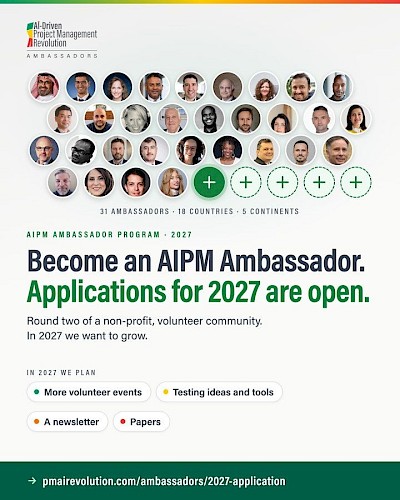
The AIPM Ambassadors are a volunteer community of practitioners who help project managers use AI in real projects. Today there are 31 ambassadors in 18 countries, on five continents. In 2026, this first cohort wrote the AIPM Practitioner Toolkit, which more than 800 professionals have requested.
We are now recruiting the 2027 cohort, and we have already received 57 applications. The program is non-profit and voluntary, and there is no fee to apply. Ambassadors get an official digital badge, early access to research and new frameworks, direct mentorship from Antonio and me, and support for their community initiatives. Everyone applies for 2027, current ambassadors included. You can learn more about the AIPM Ambassadors program here.