Episode transcript The transcript is generated automatically by Podscribe, Sonix, Otter and other electronic transcription services.
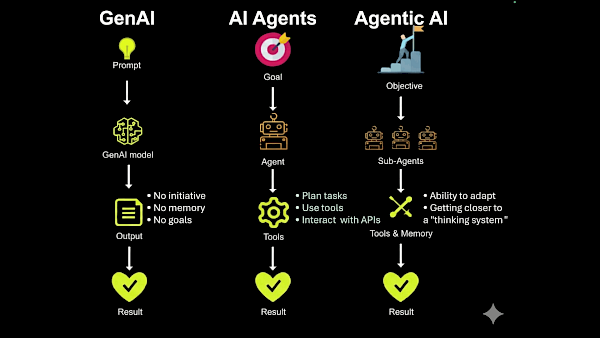
Hi everyone, here is here, and this is the 5 Minutes Podcast. And today I want to clarify a topic that is everywhere right now in technology, business, and projects. But it is still often misunderstood that the difference between Generative AI, AI Agents, and Agentic AI. I recently watched one of the clearest and best explanations I have ever seen on this subject, given by Filipa Peleja during the O'Reilly Super Stream on Generative AI, an event that I had the pleasure of hosting. The explanation was so good that I felt it was worth translating into the project language and sharing it with all of you here. Let's start with the most familiar concept, Generative AI. When we talk about Generative AI, we are mainly talking about large language models. You give them a prompt, and they generate an output. They can write texts, summarize documents, generate ideas, analyze information, or create content. But there is a key limitation that we need to be very clear about. Generative AI has no initiative. It has no goals, no intention, and no decision-making capabilities on its own. It only reacts to what we ask. And in projects, this is extremely useful. We can use generative AI to prepare reports, review risks, structured presentations, and support decision-making. But the thinking, prioritization, and accountability remain entirely human. Now, it's important for us to move one step forward and talk about AI agents. With AI agents, the model is no longer just responding to prompts. Instead, it's given a goal; based on that goal, the agent can plan tasks, use tools, interact with systems, call APIs, and execute actions in sequence. And this is a big shift. The system is no longer just answering questions. It's doing work in a project context. This means agents automatically track progress, update schedules, monitor KPIs, collect data from multiple sources, and send alerts without anyone manually triggering each step. But there are still boundaries and predefined rules. But now we are talking about operational autonomy and not just support. And then we reach the most advanced level, Agentic AI. Here we are no longer talking about a single agent. We are talking about systems of agents working together. These systems have memory, can adapt over time, create subagents, and adjust their strategy as conditions change. And this is why many people describe an Agentic AI as getting closer to a thinking system. Not human thinking, of course, but systems that can reason, adapt, and reorganize their work dynamically. And for projects, this is both powerful and challenging. We are moving towards environments where decisions are increasingly distributed, responses are faster, and human intervention is reduced. At the same time, the question becomes much bigger: Who is accountable? How do we govern these systems? Where do we set the limits? How do we manage risks and ethics? And this is the core message I want to leave with you today. This conversation is not only about technology, but it's also about the delegation of decision-making. Generative AI supports humans. AI Agents execute tasks. Agentic AI is starting to choose paths. The more we move in that direction, the more critical the role of project managers, sponsors, and leaders becomes. Not to control every action, but to define objectives clearly, set boundaries, and ensure that AI is aligned with the right outcomes. That was the key insight from Filipa's explanation, and I believe it's essential that we reflect on how we work in our projects today. I hope you enjoyed this episode. Think about that and see you next week with another 5 Minutes Podcast.