Episode transcript The transcript is generated automatically by Podscribe, Sonix, Otter and other electronic transcription services.
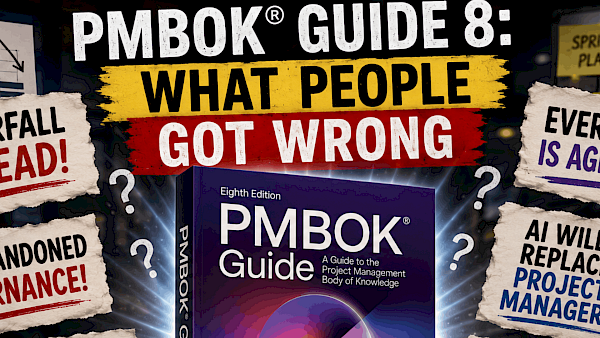
Hello, everyone. Here is Ricardo Vargas, and this is the 5 Minutes Podcast. PMI recently released the PMBOK Guide 8th Edition in several languages following the original release in late 2025 of the PMBOK in English. And as always happens, the launch comes with a lot of expectations, strong opinions, and most importantly, many misconceptions. I'm working with the translation of the flow into different languages, and I'm releasing a course specifically on the PMBOK guide, and that is exactly what I want to talk about today, because something very interesting happens every time a new PMBOK guide is published. People do not just read the guide. They project in the guide all their fears, expectations, and frustrations about the future of project management. And with the PMBOK guide, these became even more visible. The first major misconception is the idea that PMI completely abandoned traditional project management. Many people interpreted the new guide as the end of scheduling, cost, control, governance, and classical project discipline. But that simply did not happen. What changed was the way these elements are integrated into more dynamic and adaptive environments. And look, I'm talking on my behalf. I'm not talking on behalf of PMI. I don't have the authority to do that, but I want to make sure we understand what is happening because control is still important, governance is still important, and financial management is still critical. The difference is that PMI now more explicitly recognizes that projects operate in environments far more complex than they did 20 years ago. The second misconception is that everything now is agile. No, the PMBOK Guide 8 Edition does not say that everything should be agile. It reinforces something much smarter. Context matters. There are highly predictive projects. There are hybrid projects. There are adaptive projects. And there are organizations running all of them simultaneously. The problem was never waterfall versus agile. The problem was always applying the wrong approach to the wrong context. The third misconception involves artificial intelligence. Many people expected some kind of AI manual for projects, as if PMBOK had suddenly become a technology guide. AI is definitely present in the new edition. It would be impossible to ignore it. But AI appears to be a decision supporting automation and analysis capability, and not as a replacement for human leadership. Because Projects are still delivered by us, by people. The 4th misconception is probably the most dangerous one. The belief that a new framework fixes bad projects. It does not. No guide fixes toxic culture. No framework eliminates fear of escalation. No methodology creates transparency inside political organizations. Look, the PMBOK can guide. But execution is still the responsibility of leadership. Another interesting misconception is the idea that the PMBOK Guide, 8th edition, became too strategic and not practical enough. I actually strongly disagree with that. What PMI is finally trying to do is to connect operational execution with value generation. For many years, projects were seen only as the delivery of scope, schedule, and budget. Today, that is no longer enough. The market wants outcomes, it wants impact, it wants transformation, real results. And this drives me to another huge misunderstanding. The belief that professionals certified under older PMP versions became obsolete. I did my PMP exam almost 30 years ago, and that's not true. The fundamentals are still valid. Risk. still exist. Stakeholders are still critical. Communication still defines success or failure. Many of the questions I answered almost 30 years ago are still 100% valid. Leadership remains central. What changed was the environment surrounding projects? And maybe that is the biggest message behind PMBOK. The word has changed. Project changes. Speed changes, complexity changes, but the human foundation of project management remains extremely relevant. And perhaps the biggest misconception of all is that PMI is trying to replace everything that came before. I actually see the exact opposite. To me, PMBOK 8 feels much more like an attempt to integrate different disciplines, approaches, and realities. Much less tribalism, less fighting between agile and traditional approaches, less dogma, and more intelligent adaptation. Because at the end of the day, the client does not care which framework you used. They care whether the project works. Think about that. Again, I'm talking on my behalf, not on behalf of PMI. Okay, so this is my very personal opinion, and I hope you enjoy this episode and see you next week with another 5 Minutes Podcast.