Episode transcript The transcript is generated automatically by Podscribe, Sonix, Otter and other electronic transcription services.
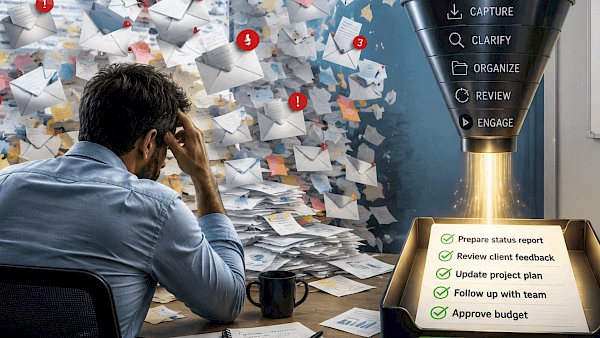
Hello everyone, here is Ricardo, and this is the 5 Minutes podcast. Today, I want to talk about the situation that may be happening in your project right now. Imagine your e-mail inbox, hundreds of messages, some read, some unread, many marked for later, several waiting for a response, and some important ones buried somewhere in the middle of the noise. Now think about your project. How many decisions are waiting to be made? How many action items have no owner? How many risks have been identified but never addressed? How many topics come up during meetings, and they just disappear without any follow-up? Many projects do not get into trouble because they lack resources or because the schedule was poorly developed. They get into trouble because they become one giant unprocessed inbox. And that's exactly the problem that the brilliant work of David Allen came to solve. When he created the GTD methodology, or Getting Things Done, he changed everything. For example, I have used GTD for the past 20 years. I don't know how to manage the work I need to do in my projects and daily life without GTD. And the core idea behind GTD is very simple. The human mind was designed to generate ideas, but not to store them. When we try to keep everything in our heads, we create stress, forget things, and lose focus. The same thing happens in projects. When decisions, issues, requests,s and risks are scattered across emails, meetings, chat messages, spreadsheets, and hallway conversations, the project starts accumulating what I like to call operational debt. And this is where the five steps of an interesting perspective for project management are. And the first step is capture. Everything that appears in the project needs to be collected and recorded. A client requests a newly identified risk, a scope change, or a pending decision. If it's not captured, it will eventually disappear. The second step is clarity. Not everything that comes into the project requires action. Some items can be discarded. Some need further analysis. Others require an immediate decision. The goal is to transform vague information into something actionable and understandable. And the third step is organized. Who owns the action? What is the deadline? Where will it be tracked? Without organization, a project becomes nothing more than a storage room of unresolved issues. The 4th step is review. And this is one of the biggest weaknesses I see in many organizations. Teams capture actions, but they rarely review their system if everything is consistent and systematically organized. Without regular reviews, action lists become outdated and lose credibility. Do you remember that schedule on the wall that has been there for the past five months? Untouched? This is just a mirror of the past and has no credibility to make your relevant decisions. And this is what drives me to the final step: execute. When priorities and responsibilities are clear, the team can focus on what truly matters. What is fascinating is that these five steps are not only useful for personal productivity, but they are incredibly powerful for project management as well. Because at the end of the day, a project is simply a collection of commitments, decisions, and actions that must be continuously processed. If your project fails chaotically, perhaps the problem is not the schedule. Perhaps the problem is that your project has become overloaded as an inbox, full of items that nobody has properly processed. And just like with e-mail, ignoring the mess does not make it disappear. It only gets bigger. Think about that, and I hope you enjoy this episode and see you next week with another 5 Minutes podcast.