Episode transcript The transcript is generated automatically by Podscribe, Sonix, Otter and other electronic transcription services.
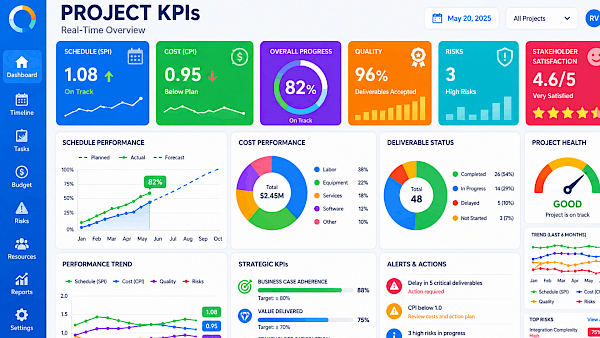
Hi everyone, here is Ricardo Vargas, and this is the 5 Minutes Podcast. And today I want to talk about a simple topic that makes a huge difference in projects, KPIs. Many teams measure a lot of things. They build dashboards, they build reports. But at the end of the day, they cannot answer a very simple question. Is my project doing well or not? And that is exactly where KPIs come in. KPIs stand for Key Performance Indicators. But in simple terms, a KPI is a number that helps you to make decisions about your project. And that is a key difference. Not every metric is a KPI. A metric can be any number. A KPI is a number that truly matters. Without KPIs, managing becomes an opinion-based decision. With KPIs, you anticipate problems, make faster decisions, and better align your teams and stakeholders. Now, let's take a look at some simple examples you can apply immediately. And let's start with KPIs related to scheduling. One of the simplest ways of doing that is the percentage of tasks completed on time. So, how many tasks are completed on time divided by the total number of tasks? This gives us an idea of how well we are performing in terms of scheduling. Another thing that I like a lot is the forecast duration minus the scheduled duration divided by the scheduled duration. This gives me an idea for each task how far they are from my baseline, how far they are, for example, from what I predicted to deliver. Another one comes from the earned value analysis, and it's called SPI or Schedule Performance Index. It's the earned value divided by the planned value. And this gives me a number that is around one. And if it's one means every minute I'm spending, I am transforming this minute into a valuable product. So, for those who are unfamiliar with earned value, I have several episodes here on earned value management that you can check in the library of podcasts. But what is important about the SPI? SPI tends to one when the project comes to a conclusion. And this is very important because when you are at 90% complete, 80% complete, SPI tends to become less valuable because it tends to go to one regardless of the delay. So SPI is a great indicator when you are on initial phases of your project. The third example is the average delay per deliverable. This helps you to understand if delays are isolated or systemic. And remember, the key here is not the number itself, but the trend over time. And we can do the same about cost. We can use CPI or cost performance index from the earned value analysis in a simplified way where we compare what is the earned value of the work we already did is divided by the actual cost. If this number is 1, it means for every dollar I'm spending, I'm transforming this dollar into a product. And this comes from the earned value analysis. I can talk about cost variance as a percentage of the cost baseline, and it's very useful, okay? But what is important truly is not just analyzing our cost performance or our schedule performance, but we need to understand that there is a very important part of this, which most people ignore, and it's called strategic KPI. A project can be on time and on budget and still fail. That is why you need to measure things like rework rate. More rework means more waste. Deliver value. Does the customer actually see value in what you deliver? Business case adherence. Is the investment still justified? Stakeholder satisfaction, like Net Promoter Score. These KPIs show if the project truly makes sense, not just if it's been executed correctly. To close, a simple rule: have few KPIs, but the good ones. Three to five per dimension is more than enough. They must be linked to decisions. They must be updated frequently. And you should avoid vanity metrics that just want to make your project look nice, regardless of what is truly happening. And let me leave you with one question. If you had to make a critical decision today, would your KPI help you? Because KPIs are not about control. They are about direction. Let's think about that. I hope you enjoyed this episode. And see you next week with another 5 Minutes Podcast. See you.