
2026: Five Insights That Will Redefine Projects
In this final episode of 2025, Ricardo proposes a reflection on changes that will profoundly impact projects in 2026. He presents five central insights:
Since 2007, Ricardo Vargas has been publishing the 5 Minutes Podcast, where he addresses in a quick and practical way the main topics on project management, business agility, risk and crisis management, among other topics.
In this final episode of 2025, Ricardo proposes a reflection on changes that will profoundly impact projects in 2026. He presents five central insights:

In this episode, Ricardo looks back at the year in projects with a mature and deeply reflective perspective, focusing on the lessons learned. He describes an intense year, marked by strong pressure for results, shorter deadlines, and increasingly tight budgets, where good planning ceased to be a differentiator and became a matter of survival. Execution took center stage, and mistakes became more costly.
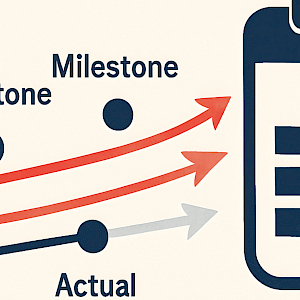
In this episode, Ricardo highlights the importance of milestones, baselines, and control points in project management, using December 31st as a powerful example of a milestone, both personally and organizationally. Just as individuals reflect on decisions and plan the future at the end of the year, projects and organizations use milestones to review budgets, compare goals, and consolidate results.
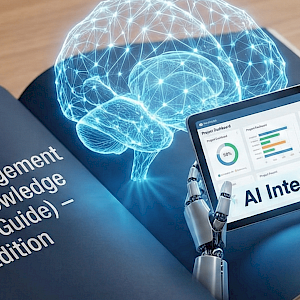
In this episode, Ricardo wraps up the discussion on the PMBOK Guide 8th Edition by highlighting the role of artificial intelligence in project management. PMI included AI in Appendix X3, presenting three adoption strategies: automation (making tasks faster), assistance (AI as a partner helping with scheduling and resources), and augmentation (expanding managers’ capabilities and decision-making).

In this episode, Ricardo explains that in the PMBOK® 8th Edition, you do not need to memorize all 40 processes. Many of them are very similar, especially in the planning phase, which alone contains 19 processes. He shows that processes like Plan Scope Management, Plan Schedule Management, Plan Financial Management, and Plan Risk Management follow the same logic: they define the “rules of the game” for each performance domain.

In this episode, Ricardo discusses a key change in the PMBOK® Guide 8th edition: the relationship between stakeholders and communication. In previous editions, communication was a separate knowledge area, but now it is considered part of stakeholder management. This shift is significant because communication only exists when there are stakeholders with different needs.
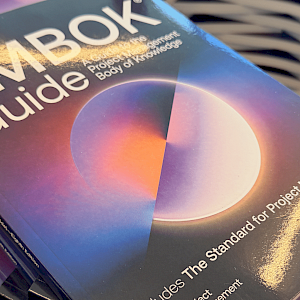
In this episode, Ricardo discusses the new edition of PMBOK 8, which brings important changes more aligned with the real work of project managers. Based on nearly 48,000 data points and two rounds of global feedback, it has become more practical, clear, and value-oriented. The old 12 principles have been condensed into six more focused ones, while maintaining good project practices.

In this episode, Ricardo discusses the role of luck and probability in project management. He explains that while luck can influence outcomes, it favors those who are prepared. Probability, he says, is not a prediction but a decision-making tool that helps manage uncertainty. Effective project managers turn randomness into results through preparation: identifying risks, creating contingency plans, defining triggers, and building buffers.

In this episode, Ricardo explains why executives need to understand the logic of project management to make informed strategic decisions. Projects drive organizational changes, such as digital transformation, new products, entry into new markets, and mergers. Without understanding how projects add value and manage risk, leaders may fail to connect strategy to execution.
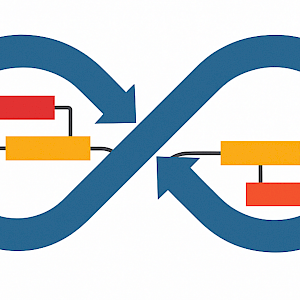
In this episode, Ricardo discusses activity loops, which occur when tasks become predecessors and successors to each other, creating cycles that make schedule calculations difficult. Although schedules are designed for linear flows, engineering and innovation projects are often iterative, with constant revisions and feedback. Looping isn't a mistake, but it needs to be represented correctly.
Read Ricardo's reviews of some of the best technical books published.
View recommendations Powered by